What happened
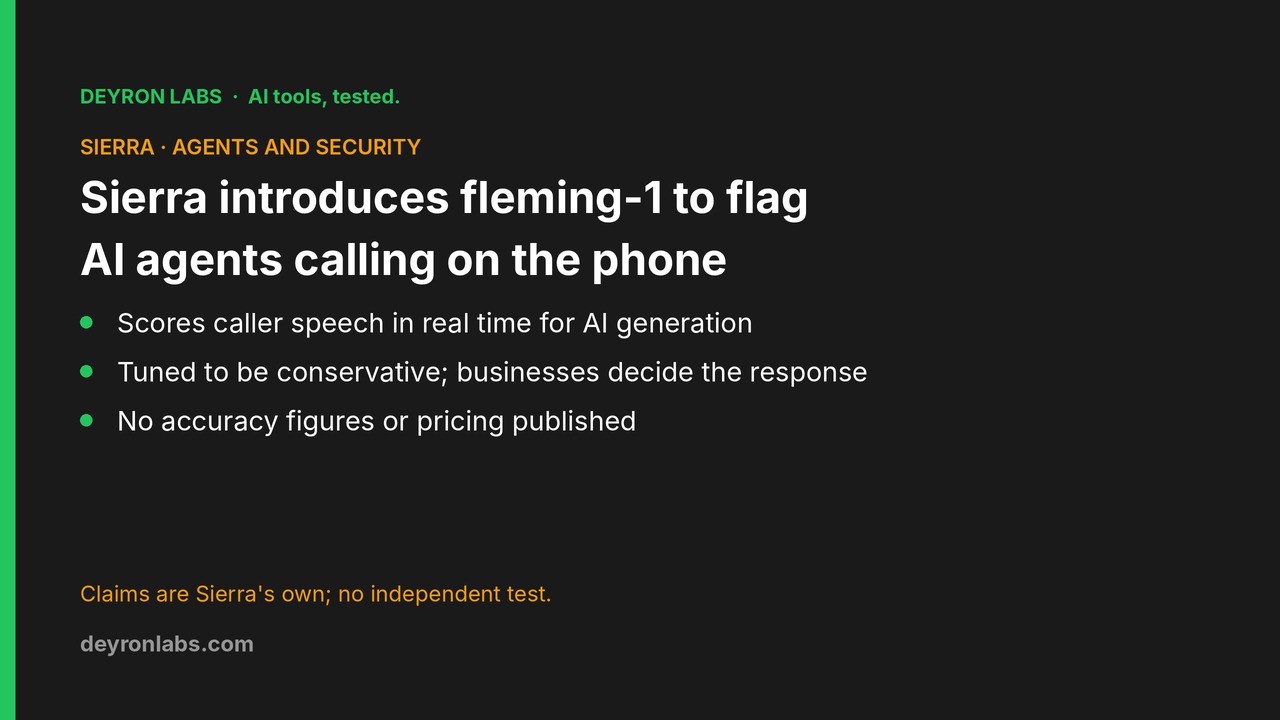
On 8 October 2026 Sierra, a company that builds customer-service AI agents, published “Caller ID in the age of agents”, introducing fleming-1. Sierra describes it as one of its own models and says it detects when the caller on a phone call is another AI agent.
Key details
All of this is Sierra’s own description.
- How it works: it analyzes caller speech in real time and scores the audio for signs of AI generation, looking beyond how a voice sounds to a human listener. It flags calls it identifies as likely AI while the call is still in progress.
- What it does with the result: it provides information only. Businesses decide how to respond.
- Tuning: Sierra says it is “tuned to be conservative by default” so that real people are not flagged by mistake.
- Availability: it works with any voice agent built on Sierra, and the only step described is turning it on. Pricing is not mentioned.
- Accuracy: the post gives no detection or error rates.
- Limits Sierra mentions: background noise, muffled audio and poor connections can hide the clues of synthetic speech, and AI voices keep improving, which makes detection harder. Sierra also acknowledges that some agents may not follow the Personal Agent Protocol, the open standard it is developing with Meta, which fleming-1 is meant to complement.
Why it matters
As businesses deploy voice agents and more callers use agents of their own, a company answering the phone may want to know whether it is talking to a person. fleming-1 is Sierra’s approach to that, and it is aimed at businesses using Sierra’s platform rather than at consumers.
Without published accuracy figures or an independent test, how well it works is unknown. The post itself says detection gets harder as synthetic voices improve.
Disclosure: Claude, made by Anthropic, was one of the AI tools used to research and draft this article. Claims about fleming-1 are Sierra’s own.
Sources
- Caller ID in the age of agents Primary source , Sierra