What happened
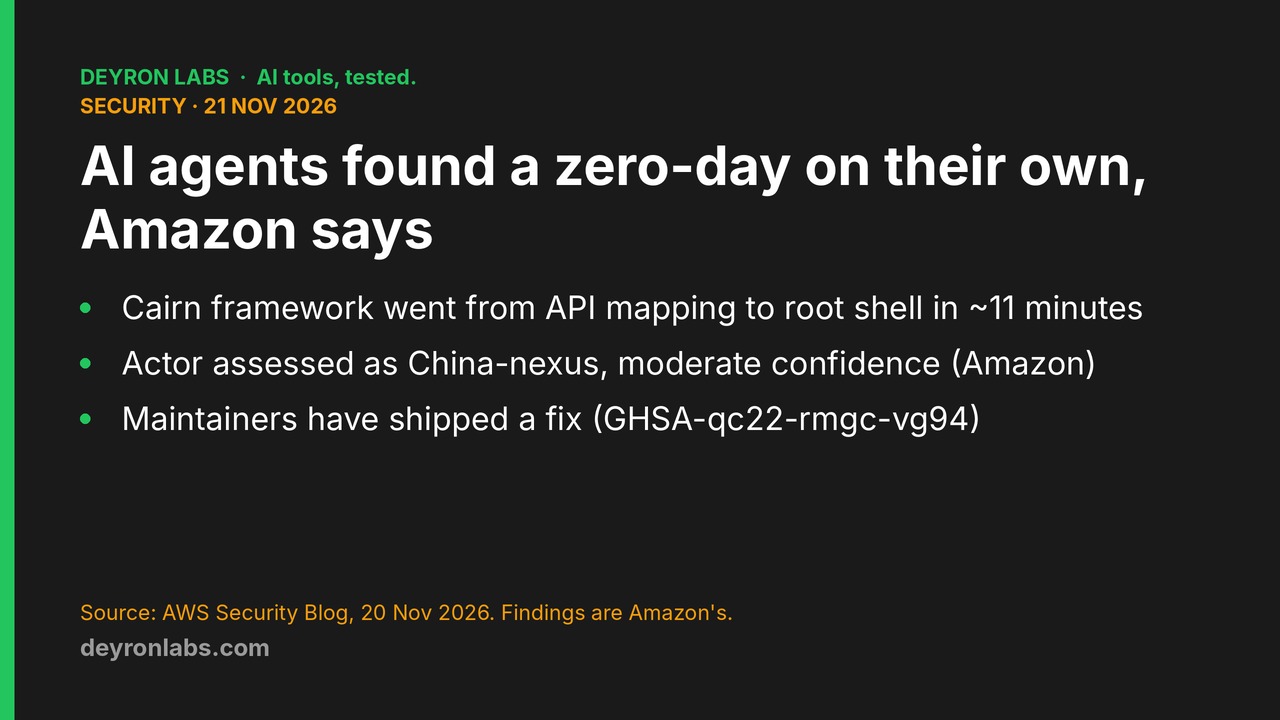
On 20 November 2026 the AWS Security Blog published a report by Amazon Threat Intelligence, written by CJ Moses, describing a campaign in which autonomous AI agents found and exploited a previously unknown vulnerability. The agents were driven by Cairn, an open-source framework for autonomous penetration testing, given the simple goal “obtain shell access”.
Amazon attributes the activity to a China-nexus actor with moderate confidence. This article reports Amazon’s findings as Amazon’s; we have not independently verified them.
Key details
All details below are from the AWS post.
- How it was found: on 10 September 2026 Amazon found a publicly hosted Cairn instance running without authentication. The prompts were in Simplified Chinese and script timestamps used China Standard Time, which Amazon cites in its attribution.
- Targets: IP addresses linked to universities in East Asia outside mainland China, over about 48 hours starting 8 September 2026.
- What failed: a roughly 16-hour, 148-action operation against a Redis instance that allowed unauthenticated access did not succeed. A GPU-server operation of more than 6 hours built about 80 usernames and tested more than 30,000 credential combinations without finding a login.
- What worked: Amazon says the agents found a path-traversal flaw in the filename parameter of an upload endpoint in an open-source medical-imaging AI application, went from mapping the API to arbitrary file writes in about 11 minutes, then obtained a root reverse shell. Amazon assesses with high confidence that this was a zero-day.
- Follow-on use: the actor then gave the agents a proxy into a second university network running the same vulnerable software.
- Response: the maintainers released a fix and a GitHub Security Advisory (GHSA-qc22-rmgc-vg94). Amazon says affected organizations outside AWS were notified through a government partner.
- Related report: the post points to a separate Gambit Security report on a financially motivated actor using Cairn against online retailers.
Why it matters
The concrete lesson from Amazon’s account is speed and persistence: autonomous agents kept probing for hours, and the one path that worked took minutes once found. That compresses the time defenders have between a bug existing and it being exploited.
Two cautions apply. Attribution here is Amazon’s assessment at moderate confidence, not a government finding. And the post describes one campaign against a handful of targets; it does not measure how common AI-driven zero-day discovery is. For teams running AI or medical-imaging tools, the practical steps are the ordinary ones the advisory points to: patch the affected software and keep agent and admin interfaces behind authentication.
Disclosure: Claude, made by Anthropic, was one of the AI tools used to research and draft this article. Details come from Amazon’s 20 November 2026 post, read on 21 November 2026.
Sources
- Chinese-nexus actor's Cairn AI agents found a zero-day on their own (read 21 November 2026) Primary source , AWS Security Blog, Amazon Threat Intelligence, 20 November 2026
- GitHub Security Advisory GHSA-qc22-rmgc-vg94 (MONAI Label), linked from the AWS post Project MONAI