What happened
On 24 November 2026 OpenAI published “Searching for distant planets with Astra,” a post about two amateur astronomers who used Codex and Astra to search public space-telescope data for planet signals. We read the post on 27 November 2026.
OpenAI says the work produced candidates only. Confirmation, it says, could take months or years.
Key details
All figures are from OpenAI’s post. We have not checked the data or the candidates ourselves.
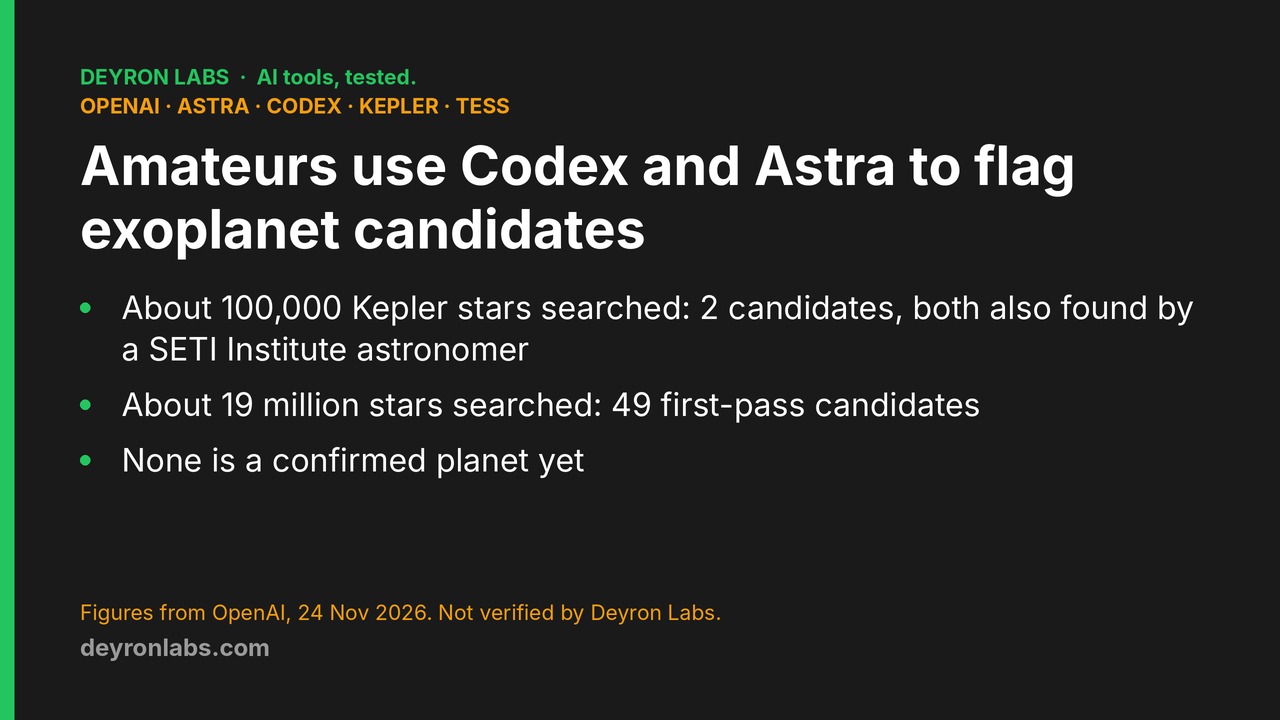
- Kevin Bond: an OpenAI engineer, who searched about 100,000 stars in NASA’s Kepler data. OpenAI says he found more than 200 signals, including 10 known planets.
- Bond’s two candidates: KIC 5689121, with a dip every 13.8 days from an object about 2.4 times Earth’s diameter, and KIC 6691030, with a dip every 4.8 days from a sub-Neptune-sized object. OpenAI says an astronomer at the SETI Institute independently found both signals in the Kepler data.
- Ethan Byrd: founder of Primitive, who searched about 19 million stars and, per OpenAI, produced 49 first-pass candidates. He sent one candidate to the TESS team.
- Data: the searches used public Kepler and TESS data. The post is a research story, not a product release, and gives no pricing or availability.
Why it matters
The result shows AI coding and reasoning tools being used by non-specialists on public datasets, which could widen who can screen astronomical data. A candidate signal is not a confirmed planet, and the post does not say how many of the amateurs’ signals will survive follow-up.
One of the two people is an OpenAI employee and the post is OpenAI’s own account, so independent confirmation by the TESS team or other astronomers is what to watch.
Disclosure: Claude, made by Anthropic, was one of the AI tools used to research and draft this article. OpenAI is a competitor of Anthropic; Deyron Labs is not affiliated with either company.
Sources
- Searching for distant planets with Astra Primary source , OpenAI, 24 November 2026