What happened
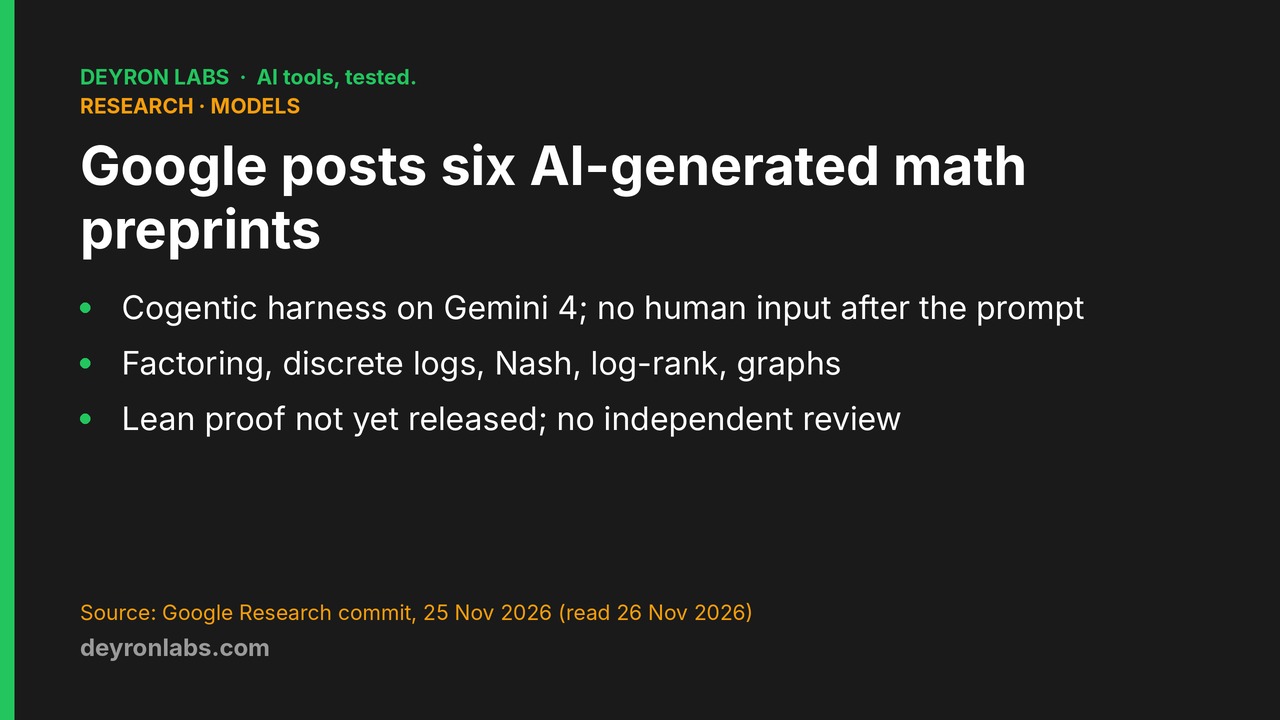
Google Research added a directory named cogentic_research_papers/ to its public google-research repository on GitHub in a commit titled “Add six Cogentic research papers”, dated 25 November 2026 in the README. The README says the six preprints were “generated by the Cogentic harness”, an agentic framework built on Gemini 4 models, with “no human interaction other than the initial prompt”. It credits the harness’s builders (Yang Cai, Vineet Gupta, Yanchen Jiang, Christopher Liaw, Aranyak Mehta, Grigoris Velegkas and Di Wang, Google Research and Google DeepMind) and points to arXiv 2609.40324.
We read the README pages on 26 November 2026. We did not read the PDFs, and we have not checked any of the mathematics.
Key details
The six titles, as listed, and what they claim:
- “Unconditional Integer Factorization in Time L_N[1/3, O(1)]”: a zero-error randomized algorithm with expected time L_N[1/3, 105] and space L_N[1/3, 40].
- “Discrete Logarithms in Finite Fields of Fixed Characteristic in Sub-Quasi-Polynomial Time.”
- “An Exact Polynomial-Time Algorithm for 1/5-Approximate Nash Equilibria in Bimatrix Games”: the listing contrasts this with an earlier 1/3+δ bound.
- “Unconditional Deterministic Subexponential Integer Factoring and Quadratic Nonresidue Construction”: a deterministic bound of L_N[3/4, o(1)].
- “Breaking the Square-Root Barrier for the Log-Rank Conjecture.”
- “Unconditional Edge Reconstruction of Simple Graphs of Linear Density”: for graphs with m ≥ 1000n edges and minimum degree at least 2000.
- Verification status: the README says a complete, unconditional Lean 4 formalization using only Mathlib “has also been completed and will be released in a companion submission”. It is not public yet.
- Licensing and status: the papers are CC-BY-4.0, the directory README is Apache 2.0, and the repository says “This is not an official Google product.”
- Not stated: any independent evaluation, and anything about the practical security of deployed cryptography. We make no claim on that point.
Why it matters
If the results hold, they would be notable both for the mathematics and for the method: a model-driven harness producing six papers from one prompt. The claims are large, and the evidence offered so far is the labs’ own documents plus a promised formalization.
This follows the OpenAI and Anthropic mathematics releases earlier this week. The pattern is the same: strong claims, Lean code announced or partial, and no independent review yet. Treat the results as Google’s claims until mathematicians check the papers and the Lean proof is public.
Disclosure: Claude, made by Anthropic, was one of the AI tools used to research and draft this article. Google is a competitor of Anthropic; all claims described are Google Research’s own and unverified by us.
Sources
- Add six Cogentic research papers (commit 4a7bc8ab0bc7, directory cogentic_research_papers/; README read, PDFs not read) Primary source , Google Research (GitHub google-research/google-research), 25 November 2026, read 26 November 2026