What happened
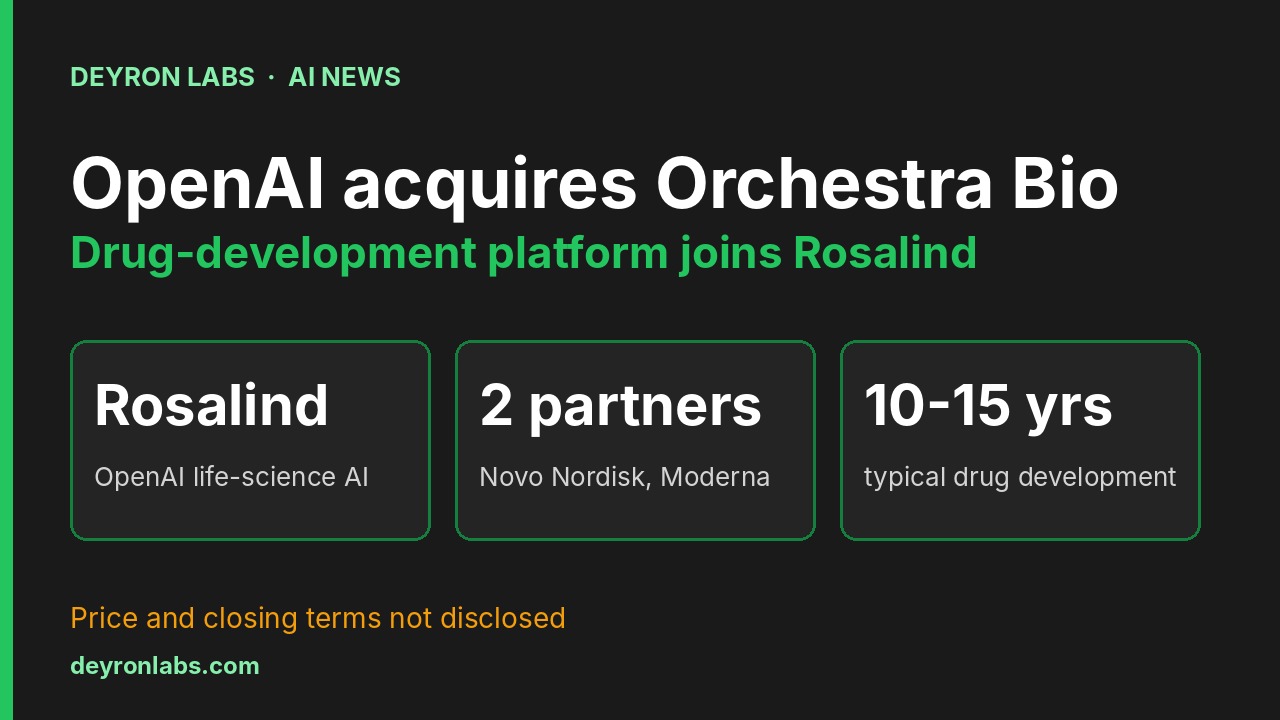
OpenAI announced on 20 October 2026 that it has acquired Orchestra Bio, which it describes as “a platform that helps biopharma teams coordinate the complex process of drug development.” OpenAI says it is “bringing Orchestra’s team and technology together with Rosalind, our AI models and tools for life sciences research.”
Key details
- What was bought: a drug-development coordination platform and its team, per OpenAI’s description.
- Where it goes: into Rosalind, OpenAI’s life-sciences line, which the post associates with GPT-Rosalind and Rosalind Workbench.
- Context given by OpenAI: drug development takes “roughly 10 to 15 years on average from target discovery to regulatory approval in the United States.”
- Partners named: Novo Nordisk and Moderna.
- Not disclosed: the deal price, whether the acquisition has closed, and when Orchestra’s technology will appear in OpenAI products.
Why it matters
The deal shows OpenAI building workflow software around its life-sciences models rather than only offering the models themselves, which is the part of drug development that pharma teams spend much of their time on. With no price, closing date or product timeline, the practical impact on customers is still unclear, and the benefits described are OpenAI’s own claims.
Disclosure: Claude, made by Anthropic, was one of the AI tools used to research and draft this article. Anthropic is a competitor of OpenAI. Details come from OpenAI’s announcement of 20 October 2026, read on 21 October 2026.
Sources
- OpenAI acquires Orchestra Bio Primary source , OpenAI