What happened
On 16 October 2026, Anthropic published “Employment at Anthropic”, a study of how AI agents have changed work inside the company itself. The page was modified on 17 October. It combines internal hiring and activity data, a survey and 17 employee interviews. Anthropic makes Claude, the AI tool that helped draft this article, so please read this as a company reporting on its own staff.
Key details
All figures below are Anthropic’s own, from its own page.
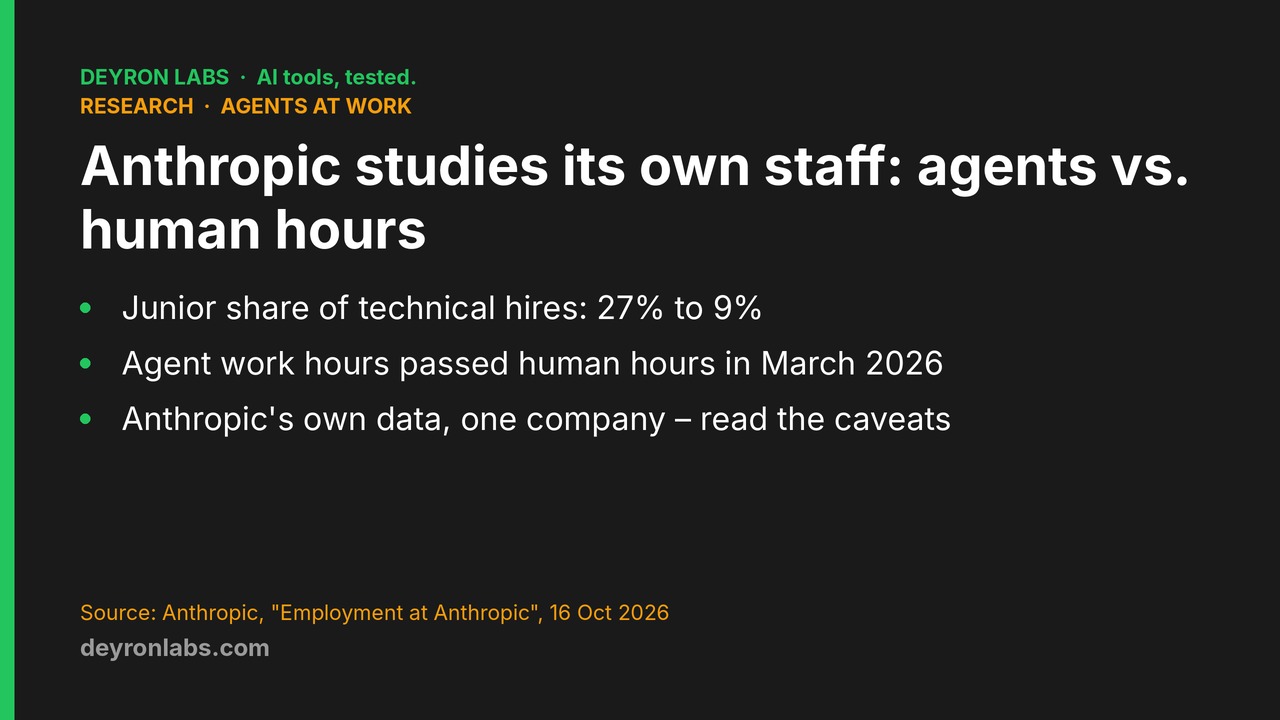
- Hiring: the junior share of technical department employment fell from 21% to 14% since early 2025, and the junior share of technical hires fell from 27% to 9%. Technical departments went from 61% to 56% of total employment over the past year.
- Agent hours: in March 2026, agent work hours passed human work hours for the first time. By August, agents working for individual employees logged six times as many hours as their human handlers. Anthropic notes these hours rest on assumptions (for example 0.75 words per token and 40-hour human weeks).
- Output: code commits per engineer reached 5x their level six months earlier. Among 192 engineers who adopted coding agents, code added rose sharply after adoption, compared with 74 who did not adopt. Agent-written code was no more likely than human-written code to be deleted or reverted later, based on proxies the authors chose.
- Human attention: about 80% of interactive Claude session time is spent waiting for human input. Meta-work such as building agent skills and monitoring pipelines rose from 10% to 22% of interactive sessions between fall 2025 and spring 2026.
- Hiring criteria: mentions of AI tool use in candidate assessments roughly tripled for technical roles and quadrupled for non-technical roles, from about 5% and 7% in 2024.
- Employee survey: agreement that work processes let people be as productive as possible went from 44% to 58% to 75% across three surveys, though the April 2026 question dropped the words “as possible”. The median employee spent 20% more time in meetings than a year earlier.
- Caveats Anthropic lists itself: the data comes from a single company whose practices, it says, are hard to replicate; employees who adopt agents may differ from those who do not; business growth is a confounder; code quality relies on proxies; tasks and themes were classified by Claude-based tools; and the link between falling junior hiring and task complexity is correlational.
Checked against the primary page on 18 October 2026.
Why it matters
This is one of the few first-hand accounts of what heavy agent use does to a team’s hiring and workload. The most concrete takeaway for readers is the human bottleneck: even at Anthropic, most of the time in an interactive session is spent waiting for a person, and the work is shifting toward directing and checking agents.
It does not show what will happen elsewhere. Anthropic says generalizing to the wider economy is speculative, the junior-hiring link is correlational, and the company sells the tools it studies. Treat it as a data point, not a forecast.
Disclosure: Claude, made by Anthropic, was one of the AI tools used to research and draft this article, and this article is about Anthropic. Figures are Anthropic’s own and have not been independently verified.
Sources
- Employment at Anthropic Primary source , Anthropic