What happened
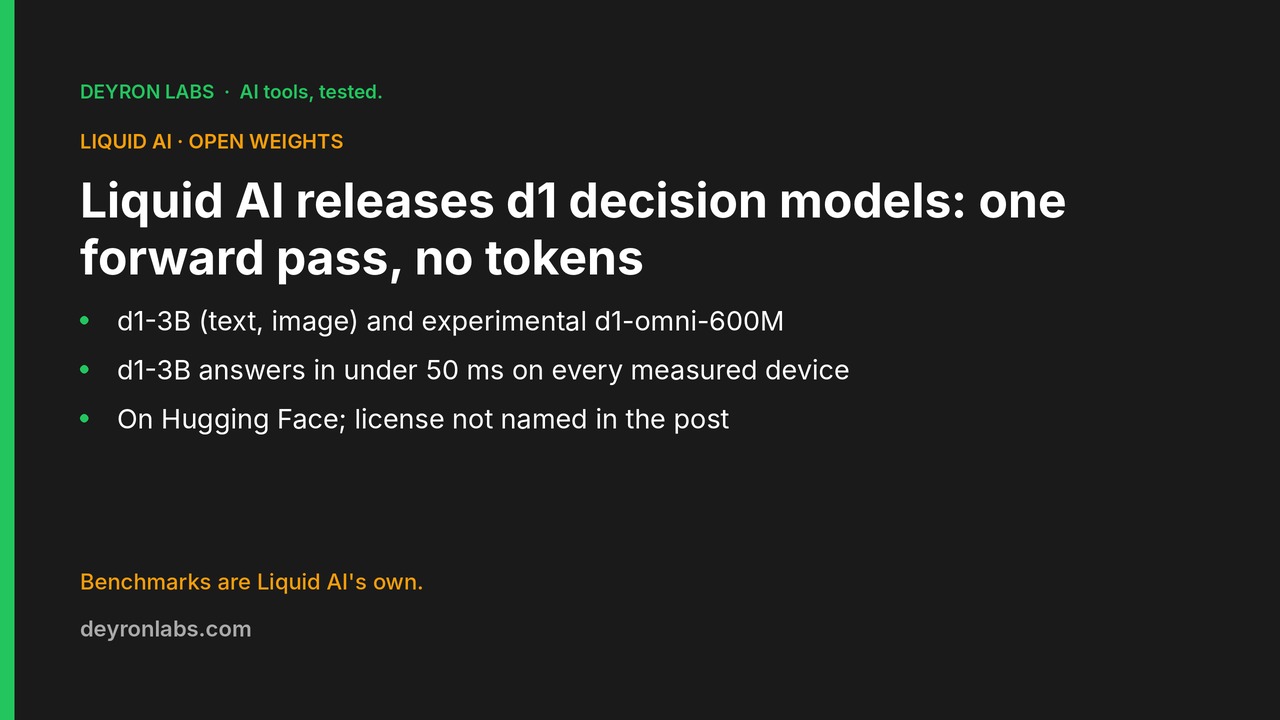
On 7 October 2026, Liquid AI published “Open d1: edge decision models for text, vision, and audio”, releasing two decision models on Hugging Face. Unlike its generative models, Liquid says they “don’t produce tokens” and “produce an answer in a single forward pass”. Both have day-one llama.cpp support, according to the post.
Key details
All figures below are Liquid AI’s own.
- d1-3B: trained from LFM2.5-VL-3B, accepts text and image inputs.
- d1-omni-600M: trained from LFM2.5-Encoder-350M, accepts text with image or text with audio, and is called “our first experimental checkpoint”.
- Decision Index v0.2.1 (public split): d1-3B scores 48.57, which Liquid says is “ahead of every model under 10B and on par with Decider 35B-A3B”. d1-omni-600M scores 15.95.
- Text benchmarks (mean of seven tasks): d1-3B 82.9 versus 81.1 for Decider 4B; d1-omni-600M 78.4 versus 77.1 for Decider 2B, at about a quarter of the parameters.
- Latency for d1-3B (single question): 8 ms on an RTX 4090, 16 ms on a Jetson AGX Thor, 26 ms on a Jetson AGX Orin and 50 ms on a Jetson Orin Nano.
- License: the post calls the models open-weight and says users can download, fine-tune and deploy them “without restrictions”. It does not name a license, so check the model cards.
Why it matters
Decision models target tasks where an application needs a choice or a label, such as routing or classification, rather than free text. Latencies of tens of milliseconds on edge hardware make that practical for devices without a data-center GPU.
The “Decision Index” and the “Decider” comparison models belong to Liquid’s own evaluation, and we found no independent results. The 600M model is explicitly experimental.
Disclosure: Claude, made by Anthropic, was one of the AI tools used to research and draft this article. Claims and benchmarks are Liquid AI’s own.
Sources
- Open d1: edge decision models for text, vision, and audio Primary source , Liquid AI