What happened
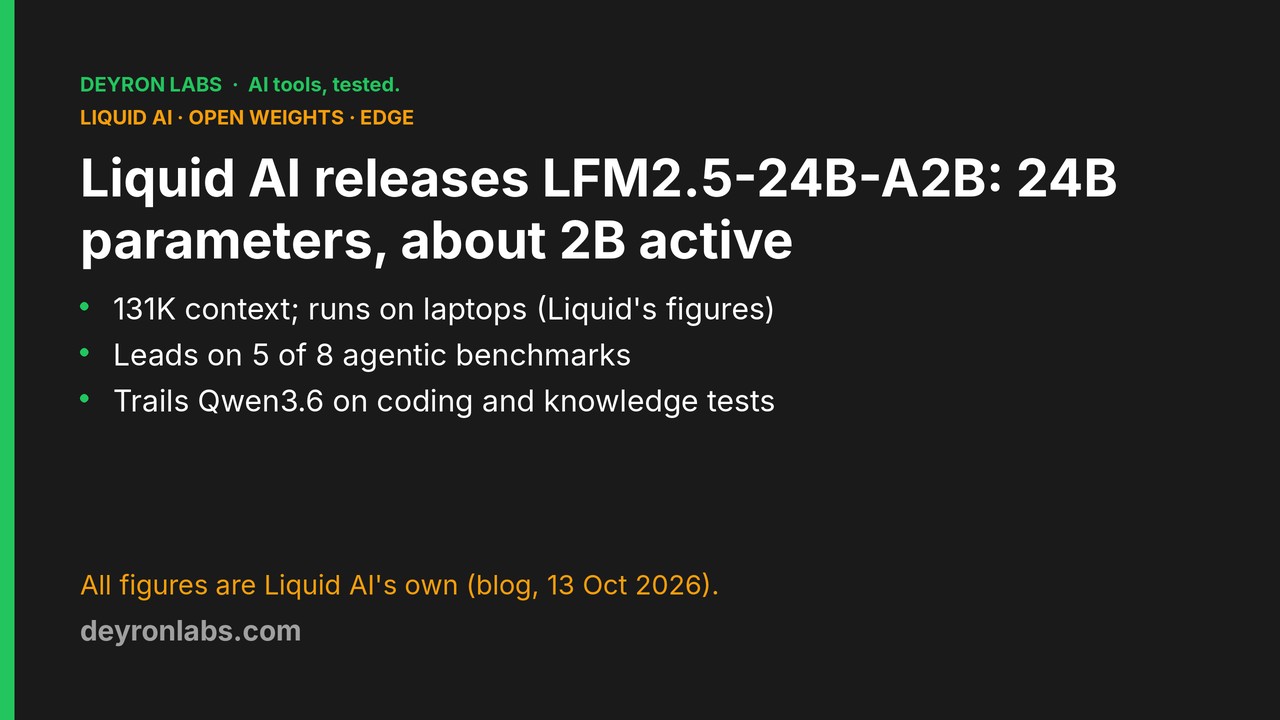
On 13 October 2026 Liquid AI published LFM2.5-24B-A2B on Hugging Face, together with a base checkpoint, LFM2.5-24B-A2B-Base. It is a reasoning-only model: it writes out a chain of thought before its final answer. Liquid describes it as built for fast, private agents that run on a user’s own device, and calls the weights open.
It follows Liquid’s d1 decision models, which we covered on 9 October, but is a different and much larger model aimed at agent workloads.
Key details
All figures below are Liquid’s, from its blog post and model card. We have not run the model.
- Size and design: 24B total parameters with about 2B active per token (the model card lists 2.45B). It uses a mixture of experts with 64 experts per block and top-4 routing, 40 layers mixing short-convolution and grouped-query attention blocks, and a 128K-token vocabulary.
- Context: 131K tokens, up from 32K in the earlier LFM2-24B-A2B.
- Training: pre-training scaled to about 33T tokens, with mid-training adding 2T tokens at 32K context and 300B tokens at 131K context.
- Benchmarks (Liquid’s comparison with Qwen3.6-35B-A3B, Gemma-4-26B-A4B-it and Nemotron-3.5-Lightning): Liquid says the model leads or matches on five of eight tool-use and agentic benchmarks. It reports 27.69 on AutomationBench (next best 8.72), 65.01 on BFCLv4 (Qwen3.6: 65.00), 80.71 on ToolSandbox and 96.75 on IFEval.
- Where it trails: Qwen3.6-35B-A3B scores higher on GPQA Diamond (83.69 vs 74.42), SWE-Bench Verified with OpenCode (66.20 vs 51.00), WebArena Verified (37.62 vs 26.75) and PinchBench (89.93 vs 83.18). The model card says it is not recommended for knowledge-heavy tasks on its own and suggests pairing it with retrieval or web search.
- Speed (Liquid’s measurements): 184 tokens/s on an Apple M5 Max, 114 tokens/s on a Ryzen AI Max+ 395, and over 21K output tokens/s at high concurrency on one NVIDIA B300.
- Availability: weights on Hugging Face; supported by llama.cpp, MLX, vLLM, SGLang and ONNX; text-only. The model card lists the license as “lfm1.0”. We did not read its terms, so we cannot say what commercial use it allows.
Why it matters
Small active-parameter models are what make local agents practical, because speed and memory use depend on the active parameters rather than the 24B total. If Liquid’s numbers hold, this one targets the tool-calling steps of an agent rather than hard coding or knowledge questions, where its own table shows larger models ahead.
Treat the comparison with caution: the benchmarks were run and chosen by Liquid, and an independent evaluation has not appeared yet. Anyone planning to build on it should read the lfm1.0 license first.
Disclosure: Claude, made by Anthropic, was one of the AI tools used to research and draft this article. Figures are Liquid AI’s own, taken from its 13 October 2026 blog post and model card.
Sources
- Run fast, private agents on-device with LFM2.5-24B-A2B Primary source , Liquid AI (Hugging Face blog)
- LiquidAI/LFM2.5-24B-A2B model card Primary source , Liquid AI (Hugging Face)