What happened
On 13 November 2026 Thinking Machines Lab published “End-to-End 4-Bit Training” on its Connectionism blog, written by Jack Cook and colleagues. The post describes how the lab trained Inkling 2 Small, the model it released on 5 November, using the BF16, MXFP8 and NVFP4 number formats on NVIDIA GB300 hardware, with NVFP4 as a 4-bit format used in the forward pass.
We read the post on 16 November 2026. It is a technical description by the lab itself: the numbers below are the lab’s, and we have not seen independent replication.
Key details
- Format claims (lab-reported): NVFP4 is stored with 3.6 times fewer bits than BF16 and runs up to 6 times faster on GB300.
- Recipe: the forward pass uses NVFP4 in the expert layers, the backward pass uses MXFP8 with re-quantization and stochastic rounding, and communication is also quantized.
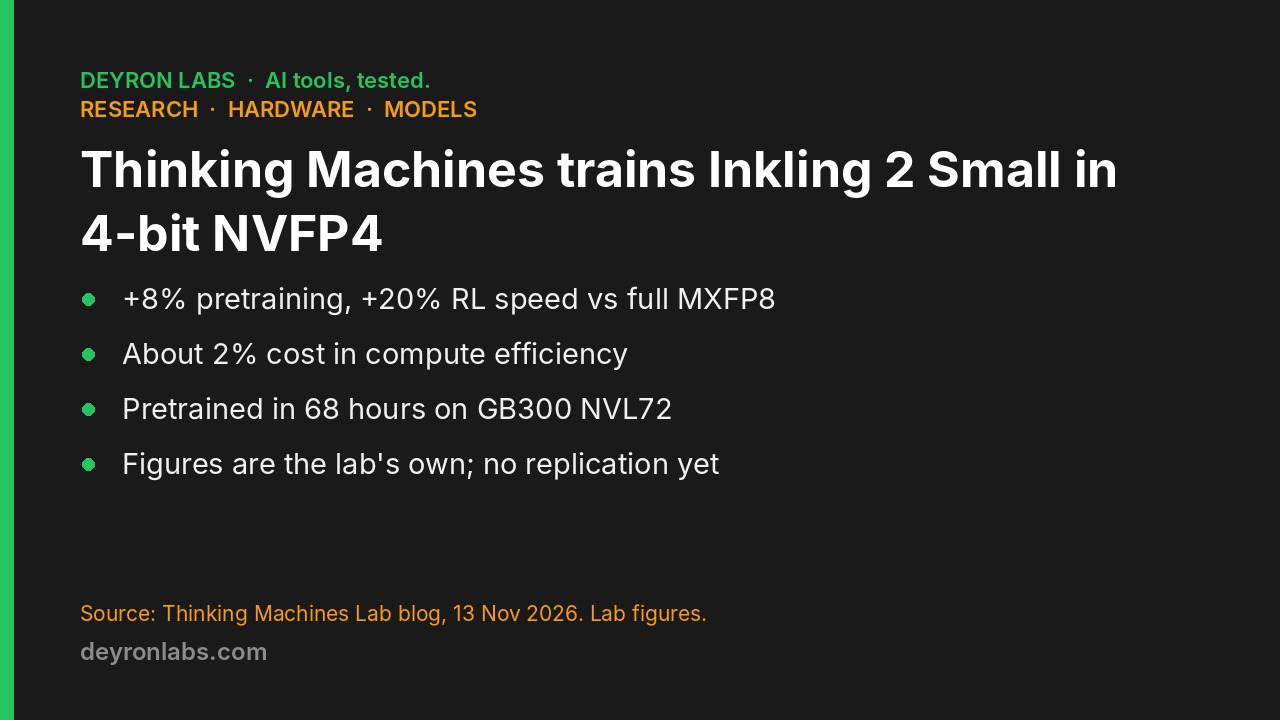
- Speed (lab-reported): the recipe gives an 8% speedup in pretraining and 20% in reinforcement learning compared with using MXFP8 throughout.
- Cost: the lab says the approach costs about 2% in compute efficiency during pretraining.
- Scale: the lab calls Inkling 2 Small the largest known model trained with a native 4-bit forward pass, pretrained in 68 hours on GB300 NVL72 racks.
- Not stated: how the 4-bit run compares with higher-precision training on final model quality outside the lab’s own evaluations, and any release of the training code.
Why it matters
Lower-precision training is one of the main ways labs cut the cost of large models, and this post is a concrete account of doing it at the scale of a 594-billion-parameter model on current NVIDIA hardware. An 8% to 20% speedup for a small efficiency penalty, if it holds, is meaningful at that scale.
It is research that explains how an existing model was made, not a new product or release. The claims will carry more weight once others reproduce them on their own hardware.
Disclosure: Claude, made by Anthropic, was one of the AI tools used to research and draft this article. Thinking Machines Lab is not affiliated with Deyron Labs; all claims in the post are the lab’s own.
Sources
- End-to-End 4-Bit Training Primary source , Thinking Machines Lab (Connectionism blog), 13 November 2026