What happened
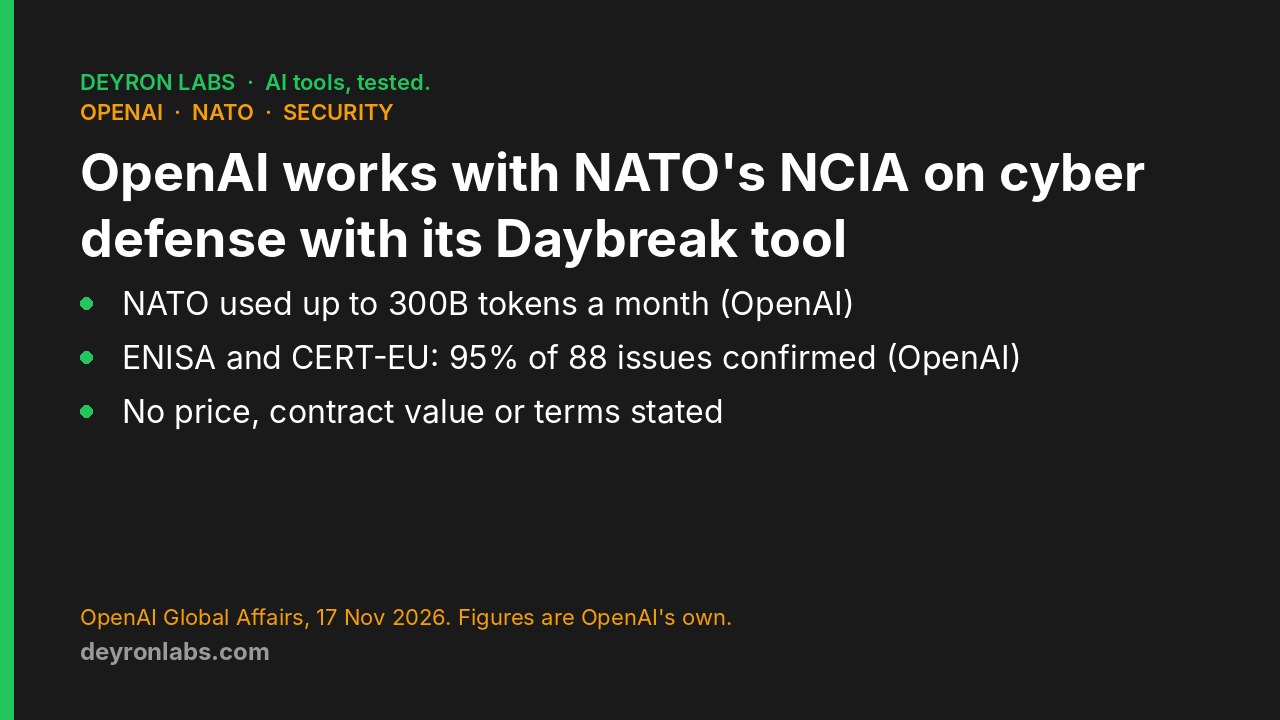
On 17 November 2026 OpenAI published “Strengthening NATO and allied cyber defenses with AI”. It says OpenAI is working with the NATO Communications and Information Agency (NCIA) to give NATO’s central institutions access to advanced cybersecurity models, and that NATO has used up to 300 billion raw input and output tokens a month. All figures below are OpenAI’s own claims; we have not seen independent confirmation.
Key details
- Daybreak: OpenAI describes Daybreak as putting advanced AI in the hands of trusted defenders for authorized security work.
- Exercise: OpenAI says it supported Crossed Swords 2026, run by the CCDCOE, with a new training track in which participants built, deployed and evaluated AI agents for cyber operations using Daybreak, with an emphasis on human oversight.
- Other governments and agencies (OpenAI): access to the cyber models for ENISA, France’s ANSSI and national agencies in Germany and Poland; Ukraine’s Ministry of Digital Transformation uses Daybreak for civilian infrastructure.
- ENISA results (OpenAI): ENISA used the models to identify four vulnerabilities in software used by EU institutions, with fixes published. OpenAI says a joint ENISA and CERT-EU report from November, covering 27 software projects, found that 95% of the 88 potential issues reviewed by maintainers were confirmed.
- CERT Polska (OpenAI): six vulnerabilities in MikroTik RouterOS, coordinated disclosure, fixes released by MikroTik.
- Quoted: Dr Dylan Browne of NCIA and Sasha Baker, OpenAI’s head of national security policy.
- Not stated: price, contract value or length, which models are covered, access conditions, or whether Daybreak is available to the public.
Why it matters
For most users nothing changes: this is about government and institutional defenders, not consumer products. It shows frontier labs moving from general cyber tools to formal arrangements with international bodies, with usage on the scale OpenAI reports. The 95% confirmation rate is a useful but self-reported measure of how often AI-found issues hold up, and the post gives no terms that would let outsiders judge the arrangement.
Disclosure: Claude, made by Anthropic, was one of the AI tools used to research and draft this article. Anthropic competes with OpenAI; all claims are OpenAI’s own, attributed as such. Facts were read on 17 November 2026.
Sources
- Strengthening NATO and allied cyber defenses with AI Primary source , OpenAI Global Affairs, 17 November 2026