What happened
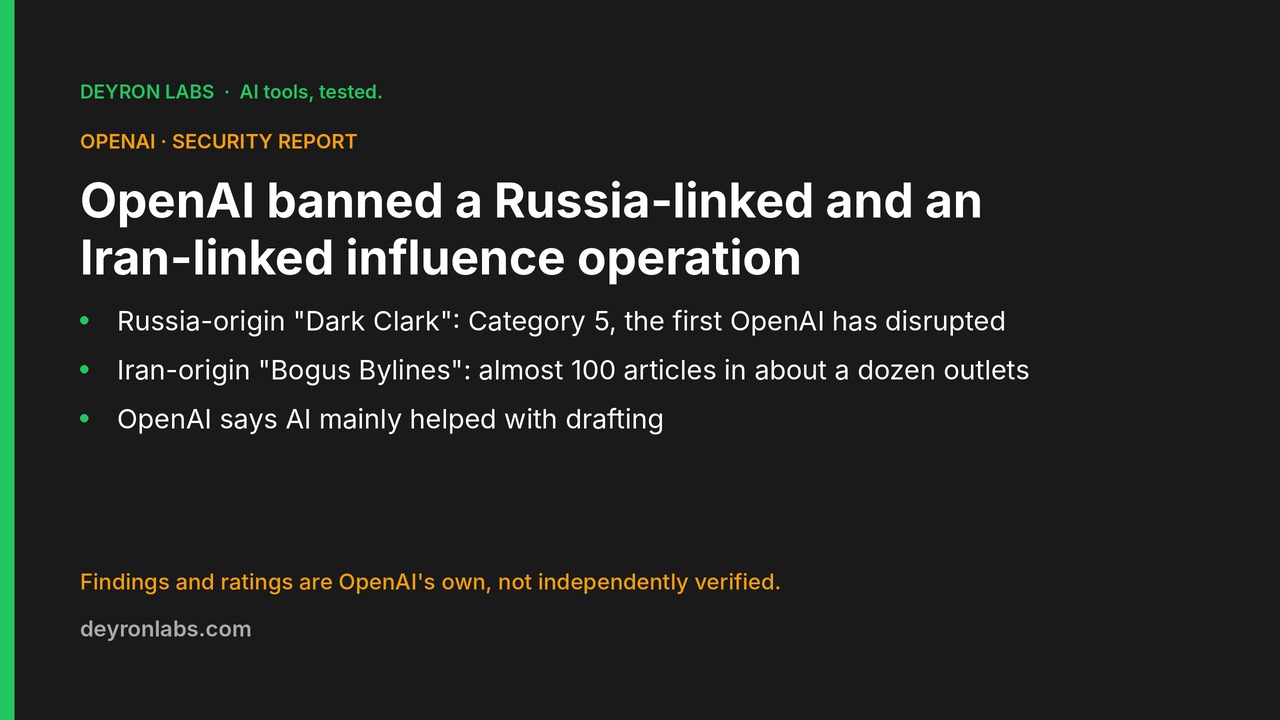
On 8 October 2026, OpenAI published “Disrupting AI-enabled ‘false front’ operations”. It says: “We recently banned two IO—one from Russia and one from Iran—that used our models” (IO means influence operation). Both operations, according to OpenAI, used fake entities or personas as a front and used AI mainly to draft content. This article reports OpenAI’s account; we have not independently verified it, and OpenAI attributes some links to outside researchers rather than to its own findings.
Key details
- Russia-origin cluster, “Dark Clark”: OpenAI says the accounts targeted Latin America, mainly to undermine Ukraine’s reputation and to influence politics in Argentina and Bolivia. Because OpenAI does not allow access from Russia, it says the operators used VPNs. They ran a self-described research platform, the “Social Research Center”, through a fake persona, and OpenAI says it identified “well over 60 articles” on that site. OpenAI says open-source researchers have linked some of the fakes to a Wagner Group successor; that attribution is theirs, not OpenAI’s.
- Examples OpenAI cites: fake emails purporting to come from an education office in Lima in May 2026, which it says led schools to hold Ukraine-themed events and reached Peruvian and Polish media; fake audio about a water shutoff in La Paz, Bolivia, in late May 2026, which was debunked and officially denied.
- Rating: OpenAI assesses the Russia-origin operation as Category 5 on the Brookings Breakout Scale and writes: “This is the first Category 5 operation we’ve disrupted since we began our reporting.”
- Iran-origin cluster, “Bogus Bylines”: OpenAI says accounts prompting in Persian generated Persian and English content, used VPNs, and posed as freelance journalists pitching articles on the US-Iran conflict. It reports “almost 100 articles” across roughly a dozen online outlets, from July 2025 to October 2026, and describes the pattern as consistent with a commercial, for-hire campaign whose client it could not identify. It rates the social media comments Category 2 and the published articles Category 4.
- Scale of the reporting: OpenAI’s chart covers 30 influence operations it has exposed since early 2024. It says operations that placed content in external publications reached Categories 4 and 5, while social-media-led ones reached Categories 1 to 3, and that both operations exaggerated their own effectiveness.
Why it matters
The notable point in OpenAI’s own analysis is where the influence came from. By its account, the AI helped with drafting and internal reporting, while the reach came from getting material into real outlets and from convincing local organizations to act on fake messages. For readers who edit, publish or moderate, that makes sourcing checks on unsolicited freelance pitches and unverified audio or email more relevant than detecting AI text.
The reports are written by a company with a stake in showing its safeguards work, and the Category ratings are OpenAI’s own judgment. Independent analysis of the same operations would be needed to confirm the scale and the attributions.
Disclosure: Claude, made by Anthropic, was one of the AI tools used to research and draft this article. Anthropic is a competitor of OpenAI. Claims about the operations are OpenAI’s own unless stated otherwise.
Sources
- Disrupting AI-enabled 'false front' operations Primary source , OpenAI