What happened
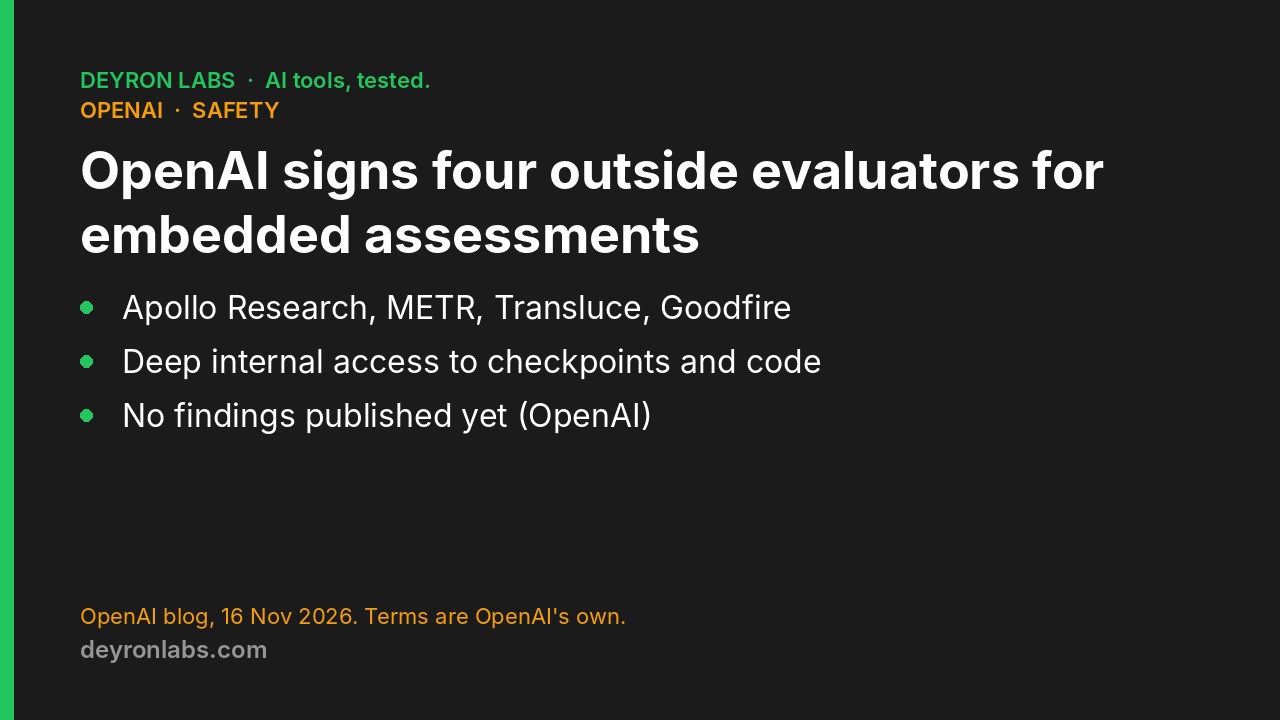
On 16 November 2026 OpenAI published “Our first phase of embedded assessments”. It says it has signed agreements with four independent evaluators, Apollo Research, METR, Transluce and Goodfire, who will assess OpenAI’s alignment and safety measures from inside the company. The post sets out what each will look at and the ground rules; it reports no results.
Key details
- Access: OpenAI says evaluators may get model checkpoints, source code, training and evaluation data, monitoring systems, technical documentation and conversations with researchers.
- Apollo Research: four claims assessed in two stages: that training did not incentivise subversion, that evaluations and red teaming do not provoke it, that models have not attempted subversion in internal use, and that the reasoning behind subversion would be detectable.
- METR: two assessments, an alignment evaluation on what OpenAI calls its largest reinforcement-learning run to date, and an evaluation of monitors. The second is only “preliminarily agreed” pending agreement on scope, and OpenAI notes its scope is narrower than METR proposed.
- Transluce: an initial evaluation of OpenAI’s post-training alignment evaluations, with a shared intention to evaluate again in about eight weeks, in early 2027.
- Goodfire: interpretability researchers whose main audience is OpenAI’s own researchers; OpenAI says they will publish results along the way.
- Ground rules: work happens on OpenAI premises and devices; the safety and security committee of the OpenAI Foundation board receives unredacted reports; OpenAI reserves the right to redact confidential information and to ask for delays under responsible disclosure; staff conversations are off the record, with an attestation mechanism.
- Disclosed compensation: Apollo and Goodfire receive payment that does not depend on results; METR and Transluce are not paid but may receive API or compute credits.
- Context: OpenAI links the program to the commitment to independent evaluations in the White House Accord on Super Intelligence.
- Not stated: any finding or result, and dates for publishing reports.
Why it matters
Outside evaluators with internal access can test things public red teaming cannot, such as training data and monitoring systems, but the arrangement is shaped by OpenAI: it can redact reports, delay disclosure and set the scope, as the METR note shows. Until the first reports appear, the program is a statement of process, and its value will depend on how much of each report becomes public.
Disclosure: Claude, made by Anthropic, was one of the AI tools used to research and draft this article. Anthropic competes with OpenAI; all claims are OpenAI’s own.
Sources
- Our first phase of embedded assessments Primary source , OpenAI, 16 November 2026