What happened
On 22 October 2026 OpenAI announced that the Decisions API is generally available. OpenAI says it is built with GPT-6 Luna and “focuses Luna’s intelligence on questions with bounded answers”, so that applications and agents can make near real-time decisions from text, images and structured inputs.
Key details
All figures below are from OpenAI’s announcement, checked on 23 October 2026. Speed and customer results are OpenAI’s own claims and were not independently tested.
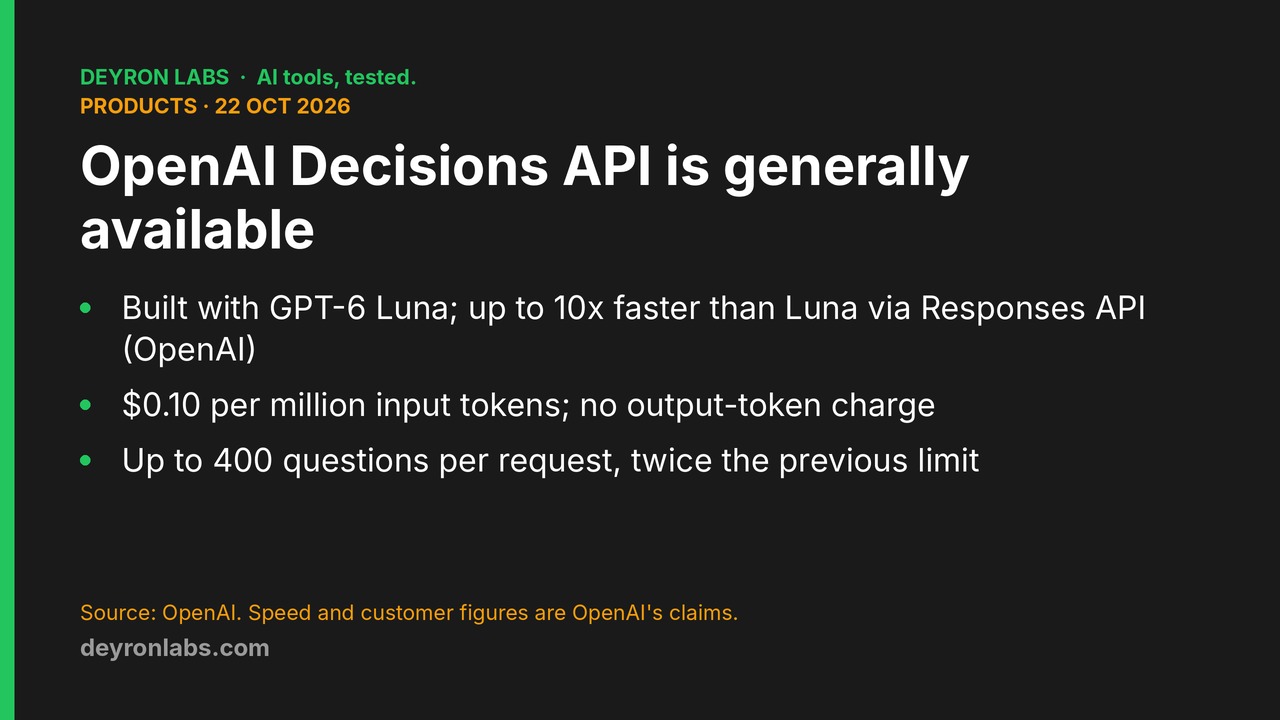
- Speed: OpenAI says decisions can run “up to 10x faster than GPT-6 Luna through the Responses API”.
- Answer types: a predicate returns a probability from 0 to 1 that a condition is true; a choice returns one of the supplied values plus probabilities and confidence; a score returns the probability-weighted average of the level indices.
- Price: $0.10 per million input tokens, and $0.01 per million for cached input. OpenAI says you pay only for input tokens, with no output-token charges.
- Limits and data: up to 400 questions per request, “twice the previous limit”. Processing is available in the US and EU, and Zero Data Retention is available to eligible customers.
- Added since the public beta: a native GPT-Live integration, prompt caching for reused context, inference residency in the US and EU, and native JSON inputs and images in instructions.
- Customer figures quoted by OpenAI: Box reports about 5x faster route selection on 30 test cases with the same accuracy as the Responses API; Datadog reports 40x faster p95 latency with comparable accuracy; Ramp reports 4x faster and 30% cheaper cost attribution than GPT-6 Luna; Sierra reports under 280 ms p95 and 90% lower cost per call.
Why it matters
Many production calls to a large model only need a yes/no, a pick from a list or a rating. A dedicated endpoint that bills input tokens only, at $0.10 per million, lowers both latency and cost for that kind of routing, filtering and classification work. Whether the quoted speedups hold on a given workload will need developers’ own testing.
Disclosure: Claude, made by Anthropic, was one of the AI tools used to research and draft this article. Anthropic competes with OpenAI. All facts are attributed to OpenAI’s announcement.
Sources
- Build more responsive apps with the Decisions API Primary source , OpenAI
- Decisions API developer guide Primary source , OpenAI