What happened
On 10 November 2026 OpenAI published “Closing the AI guidance gap in education”, an article with an accompanying policy report. It draws lessons from OpenAI’s education partnerships in Europe, the Middle East and Africa (EMEA), naming Estonia, Slovakia, Greece and Italy among others. We read the OpenAI page on 10 November 2026. We have not read the full report or the underlying ThinkYoung study, so everything below is as OpenAI describes it.
Key details
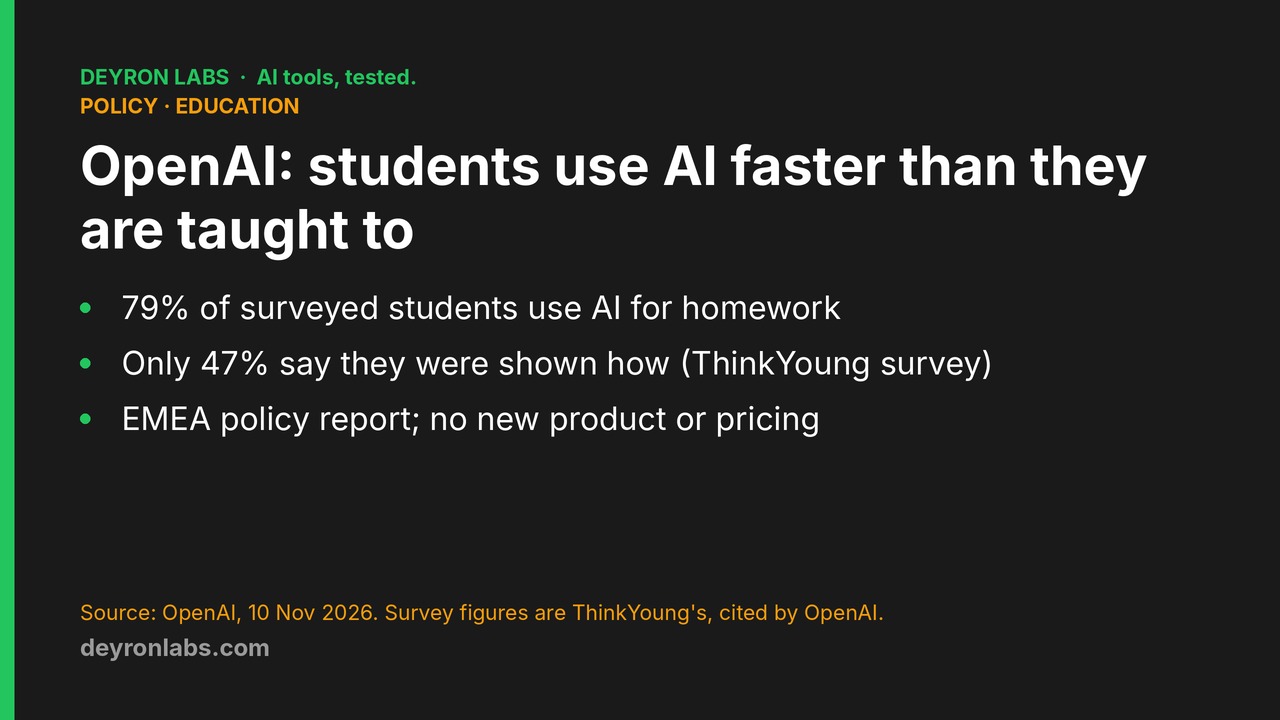
- Survey figure: OpenAI cites new research from ThinkYoung: 79% of surveyed students reported using AI for homework or assignments, but only 47% reported being shown how. The figures belong to ThinkYoung and are quoted by OpenAI. The page does not give the sample size, the countries surveyed or the method.
- Three priorities: OpenAI says its collaborations focus on equitable access to frontier AI tools, jointly designed AI literacy programmes, and ongoing measurement and evaluation.
- Five themes: the lessons are grouped as clear educational goals, educator preparation, local partnerships, critical AI literacy and credible evidence.
- Teachers: OpenAI says adoption and reported time savings for teachers are “encouraging”. It gives no figures, and describes what it has as early experiences rather than a single model.
- Research: the page mentions the OpenAI Learning Lab, which it describes as involving education researchers.
- Not stated: the number of teachers or students in the programmes, any measured time savings, prices, a new product, or any change for ChatGPT Edu or free-tier users.
Why it matters
The one hard number in the post is a survey result about student behaviour: most surveyed students use AI for schoolwork and fewer than half say they were taught how. That gap is the argument for AI literacy programmes, and the same gap exists whatever tool a student uses. The post is also a policy and positioning document from a company that sells AI products to schools and governments, and it reports no outcomes data. Readers who want to judge the claims will need the full report and the ThinkYoung survey method. Nothing changes today for people using ChatGPT.
Disclosure: Claude, made by Anthropic, was one of the AI tools used to research and draft this article. Anthropic is a competitor of OpenAI, the subject of this story. All claims are OpenAI’s own unless stated otherwise.
Sources
- Closing the AI guidance gap in education Primary source , OpenAI