What happened
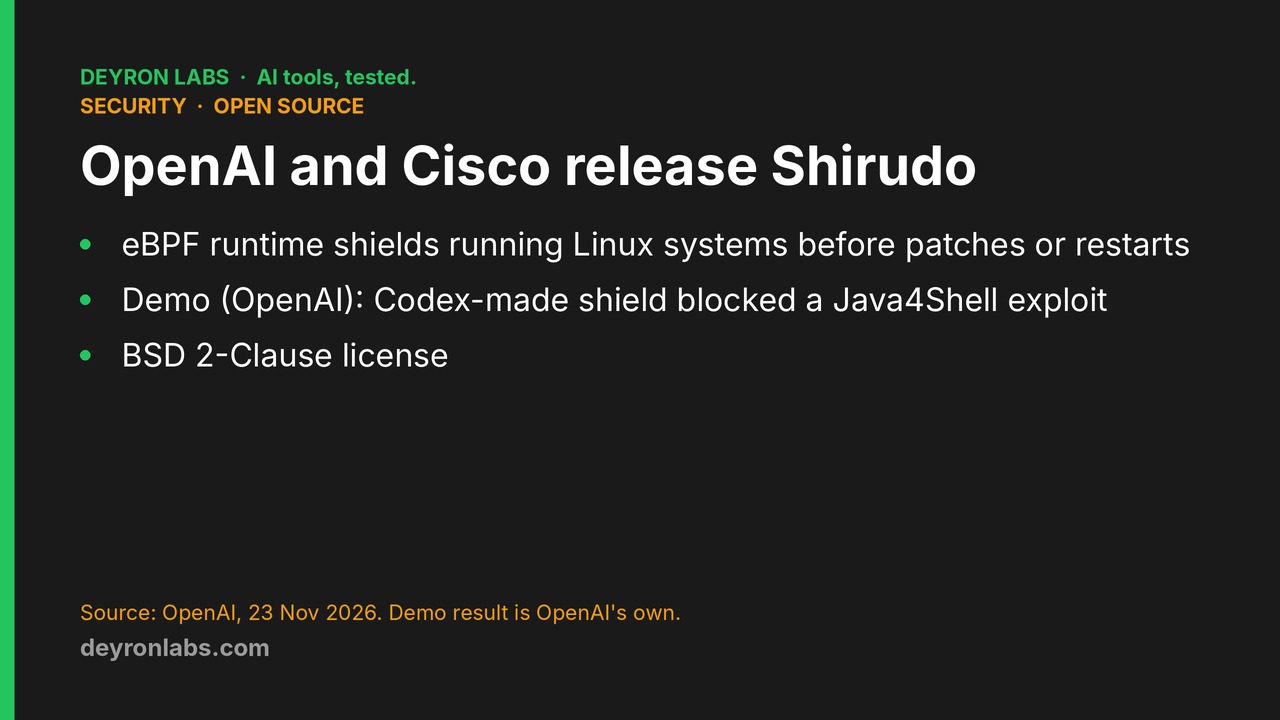
On 23 November 2026 OpenAI and Cisco introduced Shirudo, described by OpenAI as an open-source runtime that helps operators protect running Linux systems without waiting for a patch or a restart. We read OpenAI’s announcement, which is filed under Security.
Shirudo is built on eBPF and applies temporary “shields” to a running system while patches are rolled out.
Key details
- What OpenAI says Shirudo does: applies temporary shields to running Linux systems while patches roll out, with no restart needed.
- Demo (OpenAI): a shield generated by Codex blocked a Java4Shell exploit against a running Elasticsearch service, without a restart.
- License: BSD 2-Clause; the BPF programs are dual-licensed BSD and GPL, according to OpenAI’s page.
- Where to find it: OpenAI links the code repository at github.com/shirudo-dev/shirudo and documentation at docs.shirudo.dev. We did not read either.
- Not confirmed here: how many vulnerabilities shields can cover, performance overhead, how shields are validated, and Cisco’s own announcement. All of these were outside the page we read, and the demo result is OpenAI’s own.
Why it matters
Patching often lags behind disclosure because it can require restarts or testing. A mechanism that blocks an exploit on a live system, and that can have shields drafted by an AI coding agent, targets that gap. It also puts an AI-generated artifact directly in the security path, so the quality and review of generated shields becomes the key question.
Because the code is open source under permissive licenses, security teams can inspect how shields work before relying on them. Independent testing beyond OpenAI’s single demo is the thing to watch.
Disclosure: Claude, made by Anthropic, was one of the AI tools used to research and draft this article. OpenAI and Cisco are not affiliated with Deyron Labs.
Sources
- OpenAI and Cisco introduce Shirudo Primary source , OpenAI, 23 November 2026