What happened
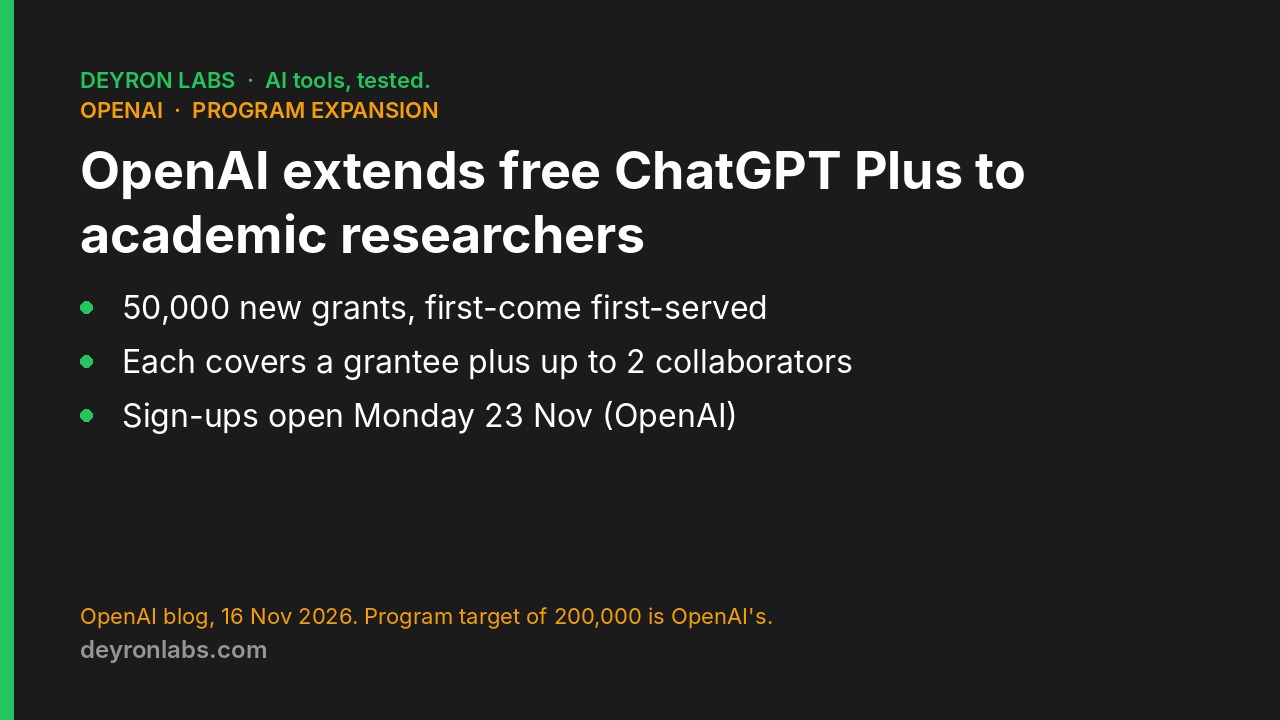
On 16 November 2026 OpenAI published a post expanding its ChatGPT for Academic Researchers program, which it describes as free ChatGPT access for “up to 200,000 researchers worldwide”. We read the post in its Romanian version; the English wording of figures and terms below is our translation, and all of them are OpenAI’s own statements.
Key details
- Pilot so far: OpenAI says the pilot began in July and that 20,000 researchers from 33 countries have joined since.
- New round: sign-ups open on Monday 23 November 2026 for 50,000 new grants, awarded in order of sign-up (first 50,000 eligible applicants); OpenAI says it is dropping the lottery. People on the waitlist, which closed on 12 November, who are eligible get an email with instructions before sign-ups open.
- What a grant covers: the grantee plus up to two collaborators get free ChatGPT Plus (the pilot gave ChatGPT Pro). OpenAI says the grants cover up to 150,000 researchers, against a program goal of 200,000, double the goal set in July.
- Data and training: by default, data shared through the program is not used to train models. Participants can use OpenAI’s “frontier models” and receive training on using them in research.
- Self-reported study: OpenAI cites a “Science at the Frontier” study of more than 1,800 researchers, which it says estimates the same work would have taken almost twice as long without AI. This is participants’ own estimate as reported by OpenAI.
- Other routes: ChatGPT Edu; a GPT-Rosalind academic plan for up to 30 free licences for up to 12 months at eligible US university labs, subject to access vetting; and a $5 million contribution to a Simons Foundation mathematics initiative.
- Not stated in the post: exact eligibility criteria (it points to an access guide), eligible countries, which models are included, and how long the Plus grants last.
Why it matters
For academics, the practical change is a first-come window on 23 November for free Plus access that also reaches two collaborators, so researchers who want in should prepare their application beforehand. For OpenAI, the program is a way to put its tools in front of working scientists, and the usage figures it cites are its own and not independently measured.
Researchers should check the eligibility guide and the data-handling terms of their institution before using the tool on unpublished or sensitive work.
Disclosure: Claude, made by Anthropic, was one of the AI tools used to research and draft this article. Anthropic competes with OpenAI; all claims are OpenAI’s own.
Sources
- Expanding ChatGPT for Academic Researchers Primary source , OpenAI, 16 November 2026