What happened
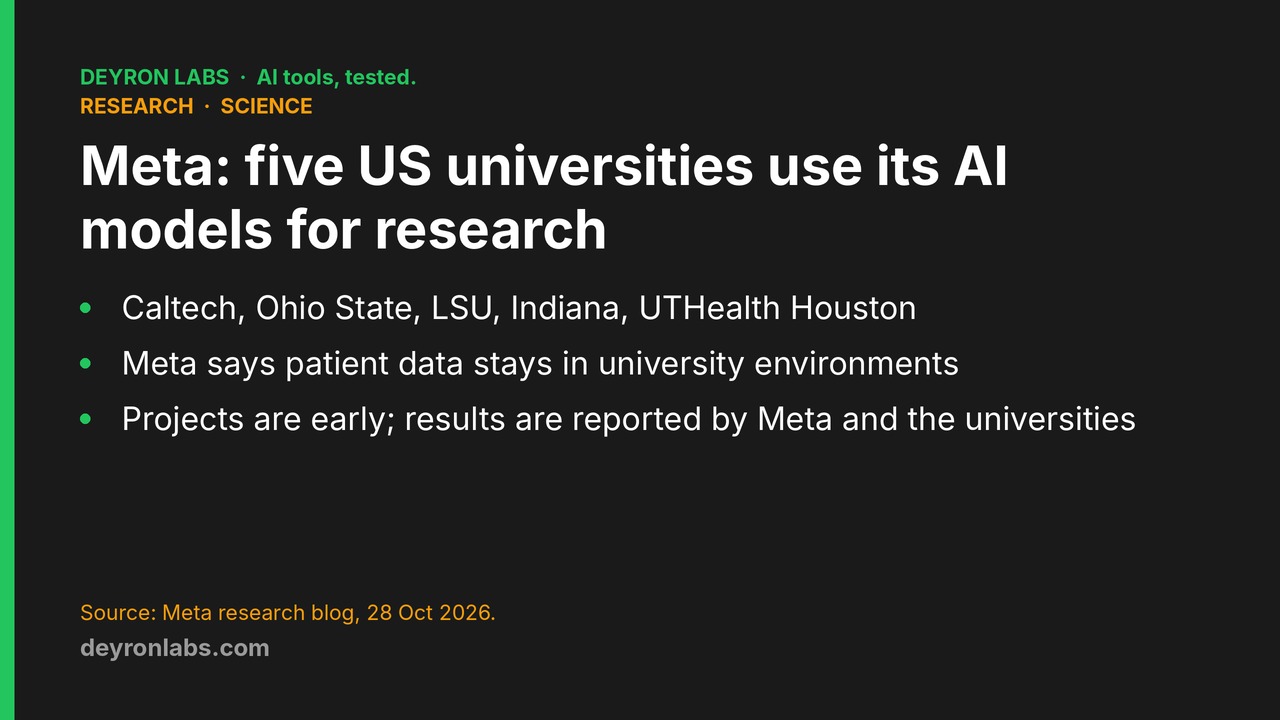
On 28 October 2026 Meta published a post on its research blog describing how it supports medical and scientific research at five US institutions: Caltech, The Ohio State University College of Medicine, Louisiana State University, Indiana University and UTHealth Houston. Meta says the support takes different forms, including access to its models, direct collaboration with Meta researchers and research funding for select projects.
The post names Muse Spark Open, which Meta calls its most capable open-weight model, the Muse Wonder and Muse Spark series, and Muse Glimmer, a 30-billion-parameter open-weight model that Meta says can run on a single consumer GPU. It also mentions Meta’s vision models SAM, V-JEPA and DINO, and the multilingual SeamlessM4T.
Key details
Everything below comes from Meta’s post, read on 29 October 2026. The projects are described by Meta and the universities; we have not verified results.
- Data handling: for healthcare projects, Meta says the universities run its models in their own institutional environments and “retain control of all patient and clinical data”, which it says will not be shared with, processed by or otherwise made available to Meta.
- Caltech: access through Meta’s first-party API for projects including MathDB Frontier, built on a database of more than 86,900 research-level open problems, and TorchLean, a Lean 4 framework.
- Ohio State: work on chest X-ray reading, heart failure and dementia care. Meta cites figures such as about 200 chest X-rays read per radiologist per day and over 5,600 patient visits a year at its Memory Disorders Clinic.
- LSU: a proof-of-concept for monitoring infant tracheostomies, multilingual coaching in nearly 100 languages using SeamlessM4T, and head and neck cancer studies, where four retrospective cohorts are complete with manuscripts in preparation.
- Indiana University: NeoSmartML+, which runs offline on low-cost Android devices, plus child word-learning research and a dementia conversational assistant.
- UTHealth Houston: ClinAgent GBM, with early tests across a sample of 65 patient cases, and a point-of-care prototype built on Meta glasses.
- License terms: the post does not state licenses for the models it names.
Why it matters
The post is partly a showcase for Meta’s open-weight models in healthcare, a field where the location of the data matters as much as the choice of model. The statement that patient data stays inside university environments and away from Meta is the most concrete commitment in it, and it is Meta’s own assurance.
Most projects are early, with proofs of concept, small samples or manuscripts still in preparation, so the post shows what is being tried more than what has been shown to work.
Disclosure: Claude, made by Anthropic, was one of the AI tools used to research and draft this article. Figures are Meta’s, taken from its 28 October 2026 post.
Sources
- How American Universities Are Using AI Models From Meta to Accelerate Medical and Scientific Breakthroughs Primary source , Meta (28 October 2026)