What happened
Google Cloud published “Introducing TPU 8tx and TPU 8i Max”, by Amin Vahdat, on 9 November 2026, cross-posted from blog.google. We read the Google Cloud version on 10 November 2026. All claims below are Google’s.
Key details
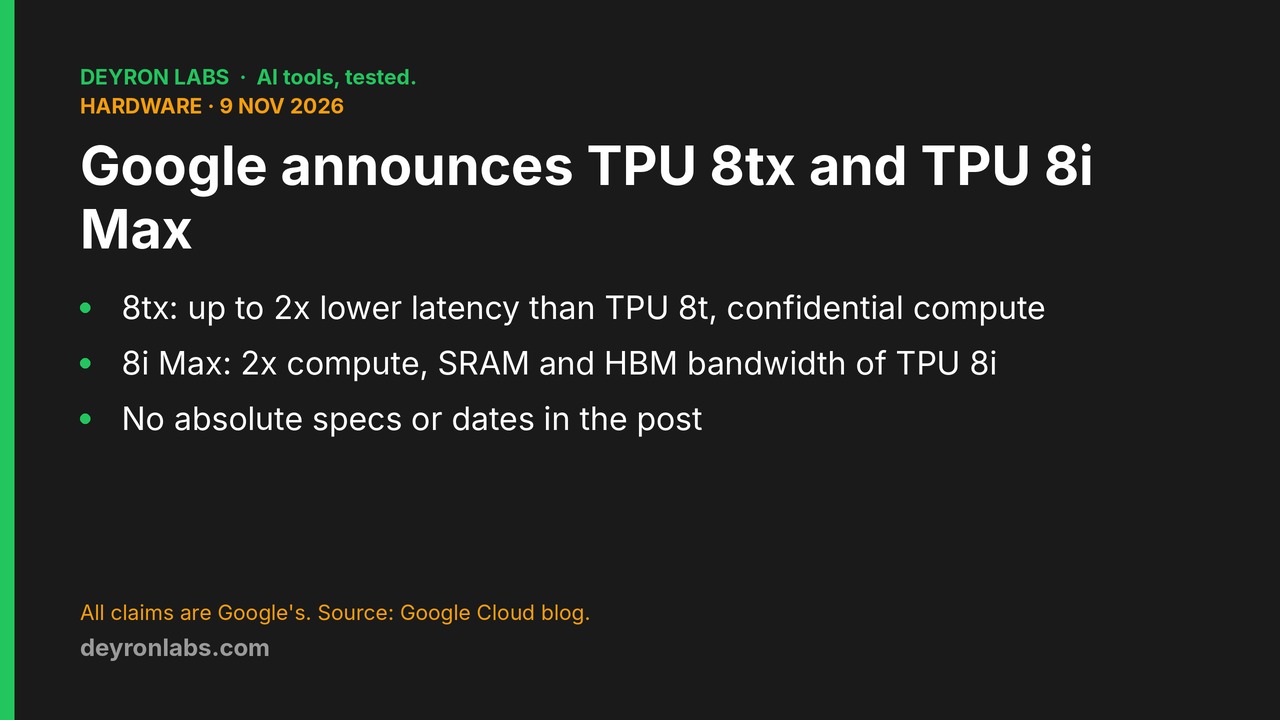
- TPU 8tx: built on the same silicon as TPU 8t and paired with 5th Generation AMD EPYC CPU hosts, with hardware-level confidential compute. Google says it offers up to 2x lower latency than TPU 8t with a near-zero performance penalty.
- TPU 8i Max: combines two low-latency TPU 8i chips in one package, giving double the compute, double the SRAM and double the HBM bandwidth of TPU 8i, per Google.
- Cadence: Google says it is shipping four new TPU systems in a single year.
- Not stated: the post contains no absolute figures such as FLOPS, memory capacity or pod size, and we did not find pricing or general-availability dates in it.
Why it matters
For most users of AI tools the effect is indirect: lower-latency, confidential serving hardware matters to companies running inference on Google Cloud, not to anyone calling a model through an app. Without absolute specs or dates, the comparisons stay relative to Google’s own earlier chips and cannot yet be checked against competing accelerators.
Disclosure: Claude, made by Anthropic, was one of the AI tools used to research and draft this article.
Sources
- Introducing TPU 8tx and TPU 8i Max (Google Cloud blog, 9 Nov 2026) Primary source , Google Cloud