What happened
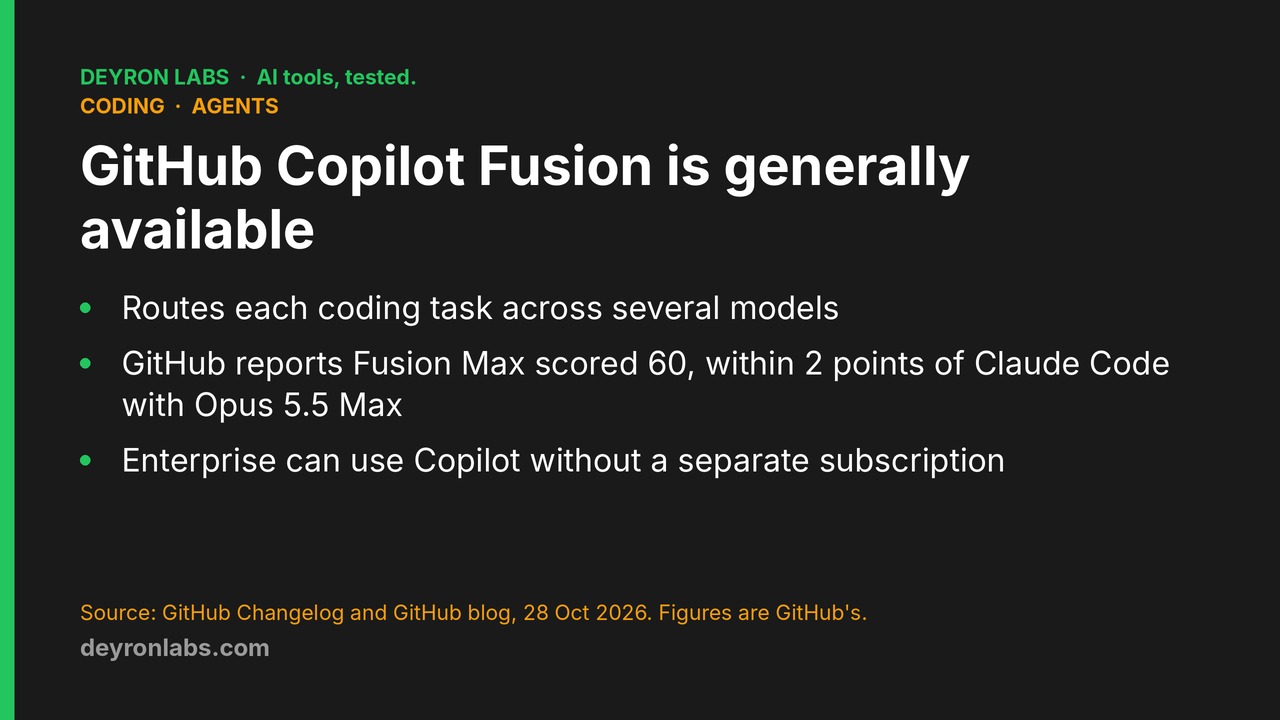
On 28 October 2026, during its Universe conference, GitHub announced that Copilot Fusion is generally available. Instead of choosing a model for each task, a user picks Fusion and Copilot decides which models to use and how they work together. GitHub says Fusion combines the multi-model orchestration of its research-preview Project HydraFusion with the fine-tuned model selection of Copilot’s auto mode.
In a separate announcement the same day, GitHub said Enterprise customers can now use all Copilot features, including the Copilot app, code review and automations, without buying a separate Copilot subscription, and pay for the AI credits they use.
Key details
Everything below comes from GitHub’s changelog and Universe post, both read on 29 October 2026. The performance and cost figures are GitHub’s own and have not been independently reproduced by us.
- Effort levels: Fusion Standard (versatile models for everyday coding), Fusion High (more capable models for harder tasks) and Fusion Max (the most capable models for the most demanding tasks). GitHub lists three workflows: Single, Cascade and Critique.
- Benchmark claim: on the Artificial Analysis Coding Agent Index, GitHub says Fusion Max scored 60, “within two points of Claude Code with Opus 5.5 Max”, at about half the average API cost per task, about half as many tokens and about 40% less time per task.
- Billing: users are billed for each model Fusion uses at that model’s standard rate. For a limited time, GitHub says users on paid Copilot plans get a 30% discount on model costs when using Fusion.
- Availability: all Copilot plans in Visual Studio Code, the GitHub Copilot app, GitHub Copilot CLI and JetBrains IDEs; support for more clients is “coming soon”. Administrators can restrict Fusion to the models enabled in their enterprise and organization policies and can set a default effort level.
- Enterprise access: available through GitHub Sales today, with self-serve “coming soon”. Existing Copilot Business and Copilot Enterprise customers can keep their current plans or switch.
- Other Universe items: a new Copilot code review tier, “Max”, which GitHub says posted the highest F1 score on ReviewBench for high-severity issues; Copilot projects in the Copilot app; and automations that can propose improvements for review.
Why it matters
Fusion turns model choice, which many teams currently make by hand, into a setting managed by the platform, and GitHub is pairing it with a time-limited discount. If the cost and speed claims hold on real workloads, it changes how developers compare Copilot with tools tied to a single model family. That is the part to test, since the benchmark is a third-party index but the results shown are the ones GitHub chose to publish.
The Enterprise change moves Copilot toward credit-based billing, which makes spend depend on usage rather than seats.
Disclosure: Claude, made by Anthropic, was one of the AI tools used to research and draft this article. The benchmark GitHub cites compares Fusion with Claude Code, an Anthropic product, so readers should weigh that comparison as GitHub’s own account.
Sources
- Route and orchestrate models with GitHub Copilot Fusion Primary source , GitHub Changelog (28 October 2026)
- GitHub Universe 2026: Evolving every layer of the stack Primary source , The GitHub Blog (28 October 2026)