What happened
On 23 November 2026 Google DeepMind published a post, written with Google Quantum AI, saying that teams of Gemini 4 agents improved well-known quantum algorithms and proved each result with Lean, a formal theorem prover. The accompanying paper, “Discovering formally verified quantum programs with AI” (arXiv 2611.09822), was first submitted on 6 November 2026 and last revised on 16 November. We read the blog post and the arXiv abstract on 24 November 2026; we did not read the full paper.
Key details
All figures below are the authors’ own, from the blog post unless noted.
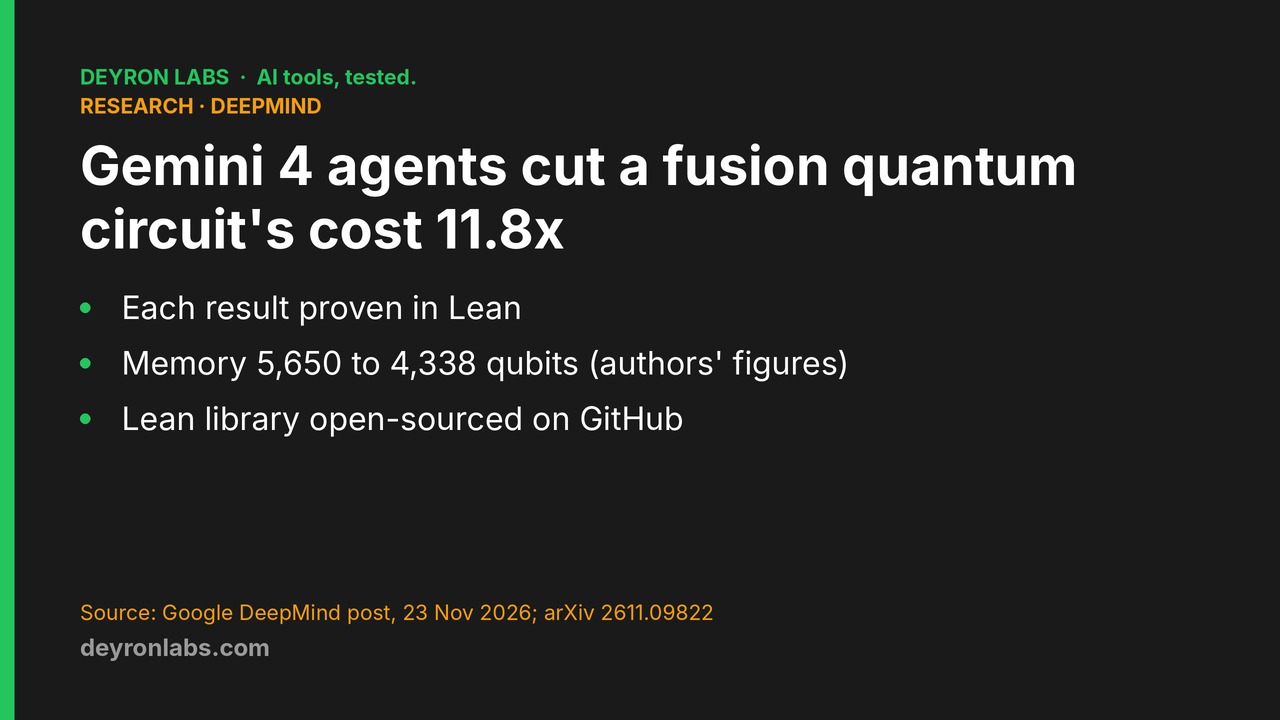
- Fusion-related circuit: the agent teams cut the required computing cost, a metric combining qubits and operations, by 11.8x, and reduced memory from 5,650 to 4,338 error-corrected qubits. The arXiv abstract rounds this to 12x.
- Photochemistry: a light-sensitive molecule simulation made 8x cheaper.
- Drug metabolism (Cytochrome P450): a 2.5x improvement, with memory reduced from 481 to 333 qubits.
- Grover’s algorithm: a 2.57x speedup for one specific implementation. Quantum arithmetic (arcsin routine): a 290x speedup.
- Method: independent agent teams per problem; ideas were verified in Lean before entering a shared notebook, and the agents met in a virtual conference every four hours, according to the post.
- Availability: the Lean library, problem specifications and verified solutions are open-sourced on GitHub; the arXiv paper is under a CC BY 4.0 license. The blog post does not state the code license.
- Limits the post states: running these algorithms in full scientific simulations would still need more resources than the first error-corrected quantum computers are likely to offer, and the large circuits cannot be tested on classical computers or today’s small quantum processors, which is why proofs are used.
- Not confirmed here: independent replication, and exactly which statements the Lean proofs cover beyond the post’s wording that each result was proven.
Why it matters
The result is a concrete example of AI agents producing research output that comes with machine-checkable proofs, a pattern also seen this week in AI-written mathematics (VP vs VNP claims), though here the verification target is the correctness and cost of programs. The practical caveat is that the savings apply to future error-corrected hardware, not to anything users can run today. Watch for independent checks of the Lean library and for whether the cost figures hold under other cost models.
Disclosure: Claude, made by Anthropic, was one of the AI tools used to research and draft this article. Google DeepMind and Google are not affiliated with Deyron Labs.
Sources
- Finding faster quantum algorithms with agents and formal verification Primary source , Google DeepMind, 23 November 2026
- Discovering formally verified quantum programs with AI (arXiv 2611.09822) Primary source , arXiv
- formal-quantum-computation (Lean library) Google DeepMind, GitHub