What happened
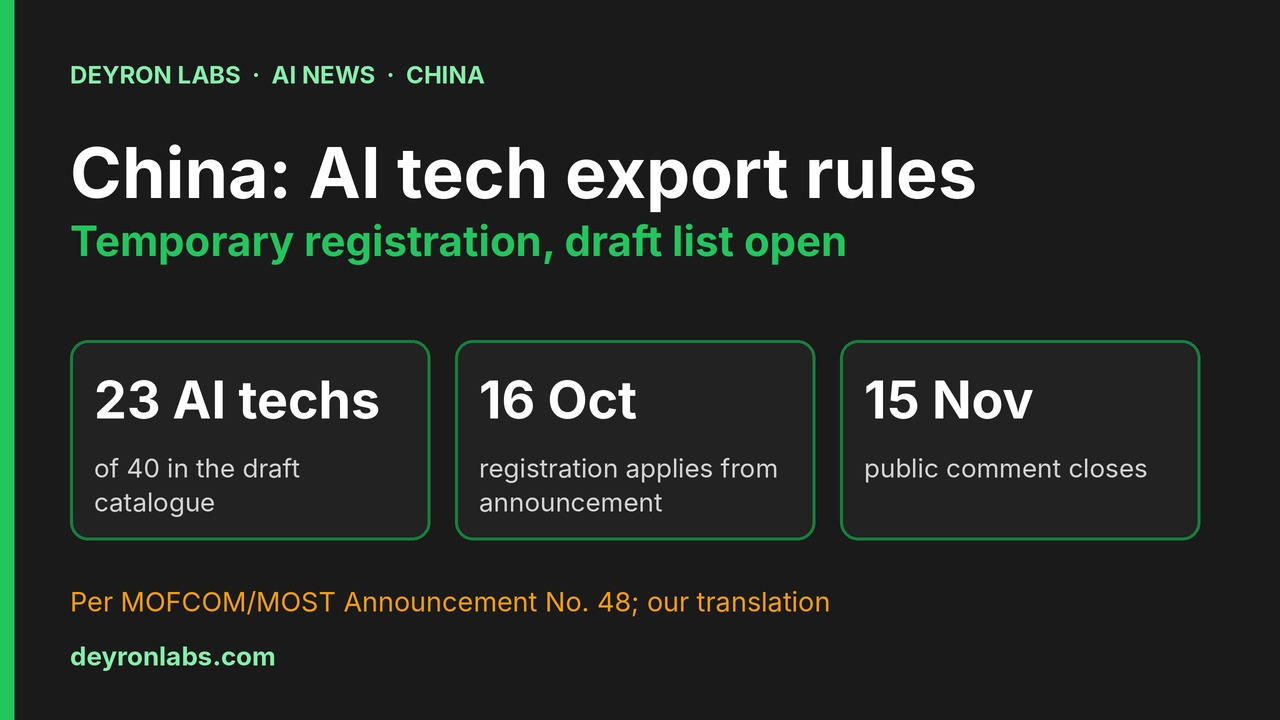
On 16 October 2026, China’s Ministry of Commerce (MOFCOM) and Ministry of Science and Technology (MOST) published Announcement No. 48 of 2026. It does two things: it opens a public consultation on revising the Catalogue of Technologies Prohibited or Restricted from Export, and it puts a temporary pre-export registration requirement on the technologies covered by the draft. The text and the ministry’s Q&A are in Chinese; the translations below are ours.
Key details
- Scope of the draft: 40 technologies in three fields. In AI, the announcement lists 23 technologies related to “large models, agents, compute clusters and information processing”. The other fields are biomedicine (5) and photovoltaics (12).
- Prohibited vs. restricted: the ministry’s Q&A says the 40 items split into 14 proposed prohibited and 26 proposed restricted technologies. It gives examples for AI: AI-driven malicious-code generation and mutation (prohibited) and AI-assisted vulnerability mining (restricted). We could not read Annex 1, which names all 23 AI items, so we do not list them.
- Registration: from the date of the announcement until the revised catalogue takes effect, exporters must register on MOFCOM’s technology-trade platform before exporting listed technologies. The announcement says this covers transfers of technology ownership abroad, licensing of domestic technology for overseas use, and cases where a foreign entity becomes owner or controller of domestic technology. Exports already begun but not finished are included. Exporters judge for themselves whether a technology is covered.
- Consultation: open from 16 October to 15 November 2026, by email, fax or post.
- Exclusions: technologies already in the public domain through open-source release or academic publication are not within the management scope, according to the announcement.
- Access vs. technology transfer: the Q&A says that offering restricted-class large models to outside users through APIs, apps or web interfaces, SaaS, or lightweight on-device deployment is not large-model technology export management, whereas localised overseas deployment of restricted technology is. Open-sourcing, Chinese firms’ self-run compute centres abroad, overseas chip fabrication and joint R&D are said to qualify for automatic-licence facilitation.
- Ministry’s stated aims: keeping AI “safe and controllable” while encouraging open and cooperative sharing; the ministry says the measures are not aimed at any specific country, region or entity and that the list will be adjusted over time.
Why it matters
The consultation and the registration requirement apply to Chinese companies that transfer, license or localise listed AI technology abroad. According to the ministry, using such models through APIs or apps, and publicly released open-source work, falls outside the controls, but the 23 AI items are still a draft and the final list could change after the comment period. Companies outside China that rely on Chinese model licences or on-premises deployments will want to watch the final catalogue.
Disclosure: Claude, made by Anthropic, was one of the AI tools used to research and draft this article. The announcement and Q&A were read in Chinese on 21 October 2026; translations are ours and may differ from official English versions. Third-party reports (for example, figures attributed to Bloomberg about model sizes) were not found in the official text and are not included.
Sources
- MOFCOM and MOST Announcement No. 48 of 2026 (Chinese original; translation is Deyron Labs') Primary source , Ministry of Commerce of China
- MOFCOM spokesperson Q&A on the announcement (Chinese original; translation is Deyron Labs') Primary source , Ministry of Commerce of China
- China moves to tighten controls on AI exports, citing national security risks Cybernews