What happened
On 10 October 2026, officials from China’s Ministry of Human Resources and Social Security (MOHRSS) spoke at a press conference in Beijing. Xinhua, China’s state news agency, reported that the ministry will launch an initiative on employment amid advances in AI. We read the Xinhua English report; we did not find the ministry’s own transcript, so everything below is as reported by Xinhua.
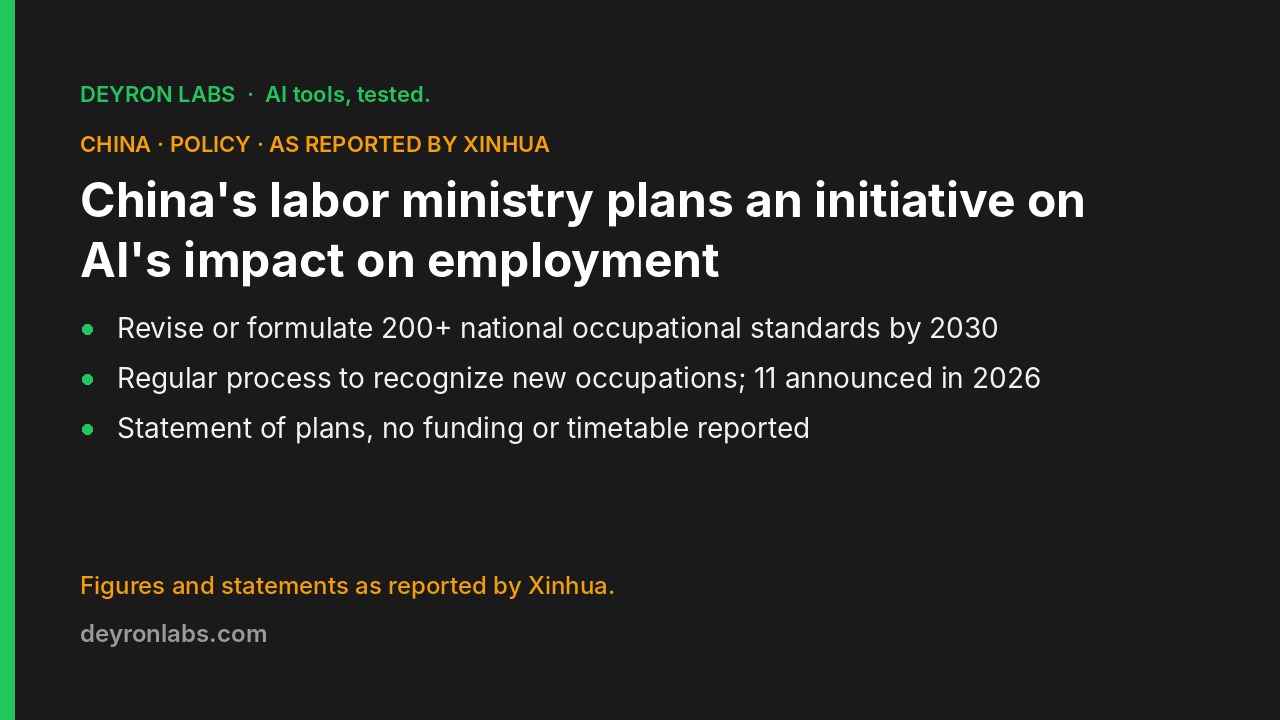
According to Xinhua, vice minister Li Zhong said China would actively address the impact of AI and other emerging technologies on employment, while promoting responsible technology development and quality jobs. Ministry official Wu Liduo said the ministry would set up a regular mechanism for identifying new occupations, in fields such as AI, the digital economy and green development, and plans to formulate or revise more than 200 national occupational standards during the 15th Five-Year Plan period (2026–2030). Xinhua reports these remarks in indirect speech, so they are paraphrased here.
Key details
This is a statement of plans, not a published rule or budget. Xinhua’s report gives no timetable for the initiative beyond the 2026–2030 plan period and no funding figures.
- New occupations: Xinhua says 72 new occupations, including AI trainers, were added over the past five years, and 11 more have been announced since the start of 2026.
- Industry figures, in Xinhua’s own narrative (no named speaker): China’s core AI industry exceeds 1.2 trillion yuan (about $178 billion) in scale with more than 6,200 enterprises, and the AI adoption rate across key industries has passed 80 percent. We could not check these figures independently.
- Hiring data: Xinhua cites the recruitment platform Maimai as showing new AI-related job postings in the new economy up 789.47 percent year on year for January to July.
- Employment statistics, per Xinhua: 10.52 million new urban jobs were created in the first nine months of 2026, 87.7 percent of the annual target, and the surveyed urban unemployment rate averaged 5.2 percent in the first eight months.
Why it matters
The report shows how a major government is framing AI and work: through training, new official job categories and updated skill standards, rather than limits on the technology. Occupational standards decide which jobs are officially recognized and what training counts toward them, so revisions can shape how workers and employers prepare for AI-related roles.
The concrete content so far is limited to intentions and counts reported by a state news agency. The details, such as which standards change and when, were not in the report.
Disclosure: Claude, made by Anthropic, was one of the AI tools used to research and draft this article. Statements are attributed to the officials and to Xinhua as reported.
Sources
- China to launch initiative to boost employment amid AI advances Primary source , Xinhua