What happened
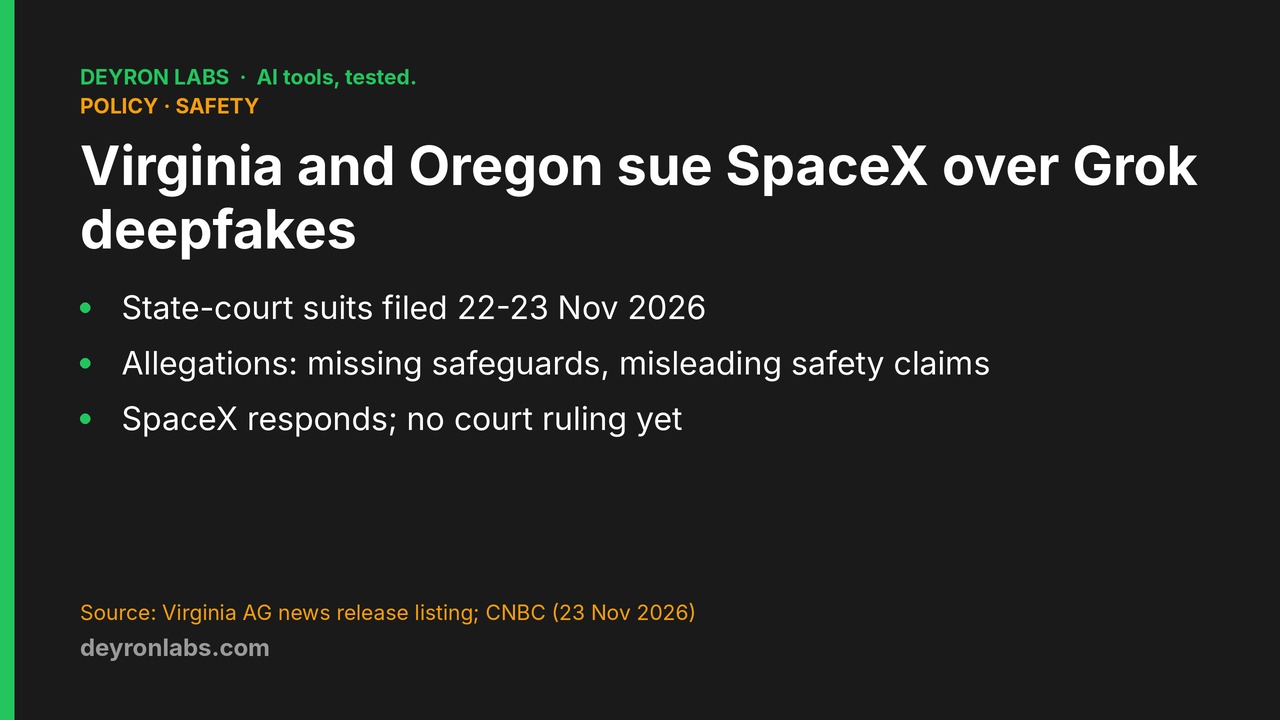
Virginia and Oregon have each sued SpaceX, the company that owns xAI, the Grok chatbot and the X platform, over how Grok handles explicit deepfakes. According to CNBC, which we read on 24 November 2026, they are the first states to sue SpaceX over Grok. Oregon Attorney General Dan Rayfield filed on Sunday evening (22 November) in Multnomah County Circuit Court, and Virginia Attorney General Jay Jones filed on Monday morning (23 November) in the City of Richmond Circuit Court. CNBC said both were awaiting the courts’ acceptance at the time it published. The Virginia Attorney General’s news-release page lists a 23 November release titled “Attorneys General Jones and Rayfield File Suit Against SpaceX, Parent Company of X, xAI, and Grok, Over Creation and Promotion of Child Exploitation and Non-Consensual Images on Platform”. We read that listing but not the release text or the complaints themselves.
Key details
- What the states allege: that SpaceX did not put safeguards in place to stop users from making explicit deepfakes with Grok and X, including what the states describe as AI-generated child sexual abuse material, and that it falsely presented Grok and X as generally safe. These are the attorneys general’s allegations, not findings by a court.
- Legal basis (as reported by CNBC): Virginia cites its Consumer Protection Act; Oregon cites its Unlawful Trade Practices Act.
- What they ask for (as reported by CNBC): in both states, injunctions, civil penalties, disgorgement and costs; Virginia also seeks restitution for consumers. Virginia’s release listing says the case is about people who “were misled by the company’s false reassurances that their data and images would be safe on the platform.”
- SpaceX’s response (as reported by CNBC): the company said it takes action against accounts that try to bypass its protections and notifies authorities, and that people who create such material “should be prosecuted”.
- Context (per CNBC): the suits join other legal and regulatory actions over Grok in several jurisdictions, including the UK, Spain, Ireland, France and California.
- Not yet known to us: the text of the complaints, case numbers, the date a court accepts the cases, and any evidence the states have gathered beyond what they have described publicly.
Why it matters
For anyone building or deploying image-generation features, the suits show state attorneys general using consumer-protection law, not AI-specific statutes, to test whether a company’s safety statements match what its product allows. Whether the claims succeed depends on evidence and rulings that do not yet exist, so the practical signal for now is the legal theory and the remedies sought: injunctions that could force product changes, and civil penalties. Readers should treat everything above as a description of claims; SpaceX has not been found liable.
Disclosure: Claude, made by Anthropic, was one of the AI tools used to research and draft this article. Anthropic competes with xAI; Deyron Labs is not affiliated with SpaceX, xAI, Virginia or Oregon.
Sources
- Attorneys General Jones and Rayfield File Suit Against SpaceX, Parent Company of X, xAI, and Grok (news release listing, 23 Nov 2026) Primary source , Virginia Office of the Attorney General
- SpaceX sued by 2 states over AI deepfake porn, Grok safety claims CNBC