What happened
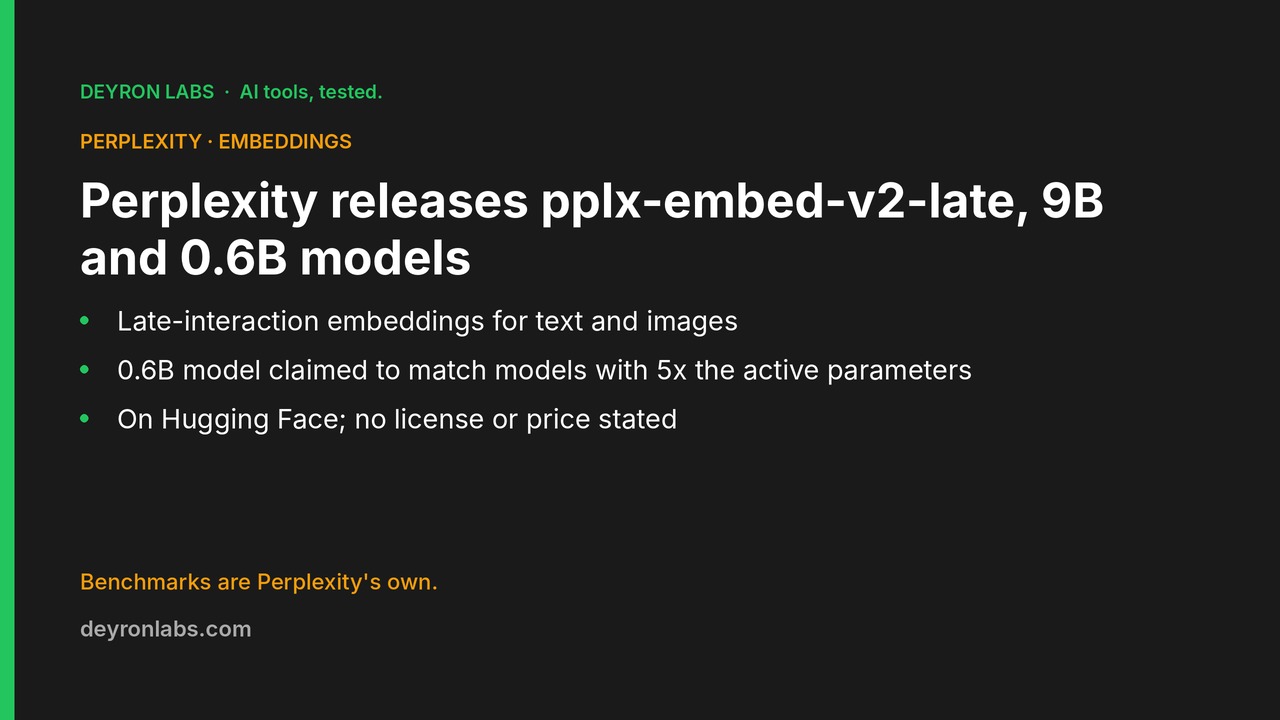
On 7 October 2026, Perplexity Research published “Multimodal embeddings beyond a single vector”, introducing a family of late-interaction models for text and image retrieval. Late interaction keeps token-level vectors instead of compressing a document into one vector. The post says both models “are publicly available on Hugging Face”.
Key details
All numbers below are Perplexity’s own, as reported in its post.
- Models: pplx-embed-v2-late-9B, described as the maximum-quality option and distilled from an 18B teacher, and pplx-embed-v2-late-0.6B, with 594M total parameters, pruned from a Qwen3.5-0.8B starting point. Both output 128-dimensional token embeddings and share one embedding space.
- Retrieval results: on domain-specific text retrieval (72 tasks, nDCG@10), 81.3% for the 9B model and 78.0% for the 0.6B model; on ViDoRe(V3) visual documents (nDCG@10), 65.2% and 62.3%.
- Other results: Q2D-Web Recall@1000 of 74.8% (9B) and 73.6% (0.6B) against a previous best of 69.3%; MADQA accuracy of 92.4% and 90.1%; and BrowseComp+ accuracy of 64.0% for the 9B model.
- Claim about the small model: Perplexity says its 0.6B model “matches models with five times as many active parameters”.
- Not in the post: a license, a price, and a timeline for the API. Perplexity says it plans to offer late-interaction, dense and contextual embeddings on its API Platform later.
Why it matters
Late-interaction models can retrieve more precisely than single-vector embeddings, at the cost of storing many vectors per document. A 0.6B model that Perplexity says holds up against much larger ones would be easier to run, if the results replicate.
Without a stated license, developers should read the Hugging Face model cards before using the models commercially, and test them on their own data, since all benchmarks come from Perplexity.
Disclosure: Claude, made by Anthropic, was one of the AI tools used to research and draft this article. Claims and benchmarks are Perplexity’s own.
Sources
- Multimodal embeddings beyond a single vector Primary source , Perplexity