What happened
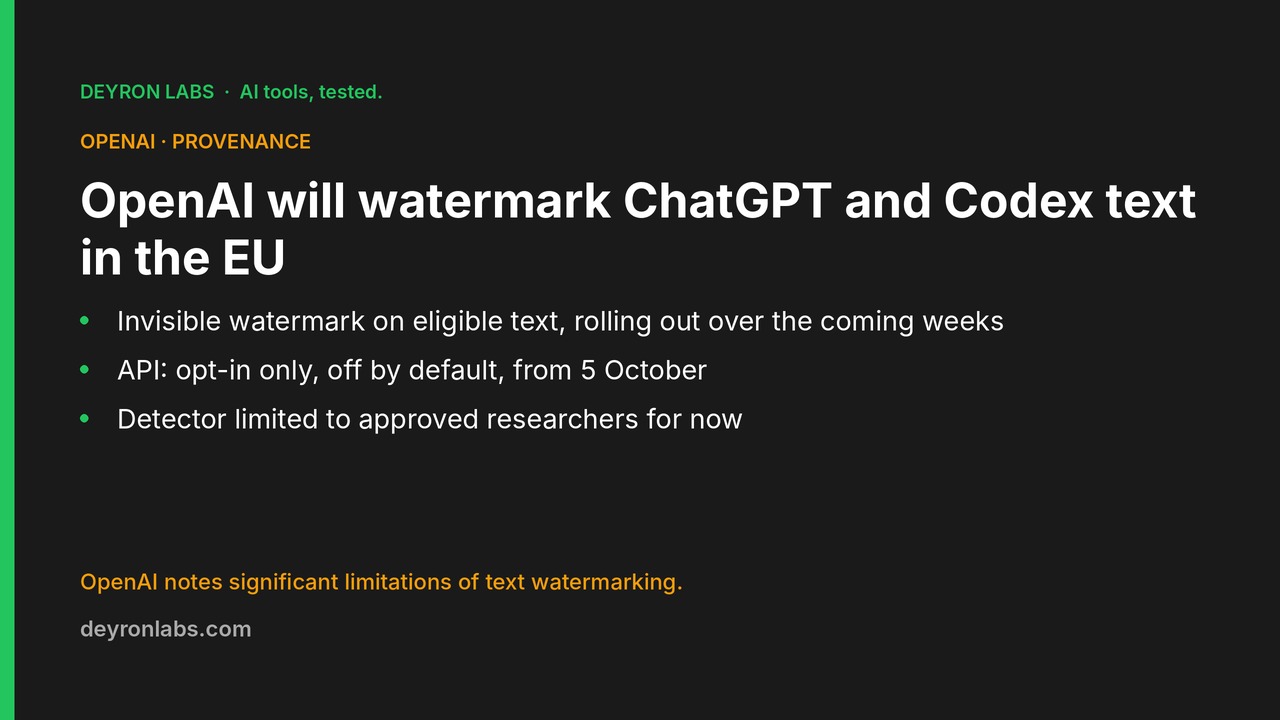
On 5 October 2026, OpenAI published “Our approach to EU text provenance rules”. It says that “over the coming weeks, we will add an invisible watermark to eligible ChatGPT and Codex text output in the European Union”, on all plans. OpenAI describes the watermark as a statistical signal added to a model’s word choices, produced by technology it calls textGrain.
Key details
- EU users: eligible ChatGPT and Codex text output on all plans, rolling out over the coming weeks.
- API: opt-in only, for select models, available from 5 October 2026 for customers worldwide. OpenAI writes that “text watermarking will remain off by default in the API”.
- Cloud partners: OpenAI says watermarking for its models accessed through partner clouds is planned for the coming weeks.
- Detector: applications for access to OpenAI’s text watermark detector opened on 5 October, initially limited to approved researchers and expert organizations.
- Caveat from OpenAI: “Text watermarking and detection remain early technologies with significant limitations, and views about their benefits and responsible uses are still developing.”
- Not in the post: the post as we read it gives no accuracy figures or false-positive rates, and we did not check how the watermark behaves after text is edited or paraphrased.
Why it matters
For people in the EU who use ChatGPT or Codex, text they generate may start to carry a signal that approved parties can later check with OpenAI’s detector. Because the detector is limited to researchers and expert organizations for now, ordinary users and publishers cannot check text themselves.
The post presents this as OpenAI’s approach to EU rules on text provenance. It does not claim the watermark can reliably prove that a text was written by AI, and OpenAI itself lists limitations. Treat any future detection result as a signal, not proof.
Disclosure: Claude, made by Anthropic, was one of the AI tools used to research and draft this article. Anthropic is a competitor of OpenAI. Claims about the watermark are OpenAI’s own.
Sources
- Our approach to EU text provenance rules Primary source , OpenAI