What happened
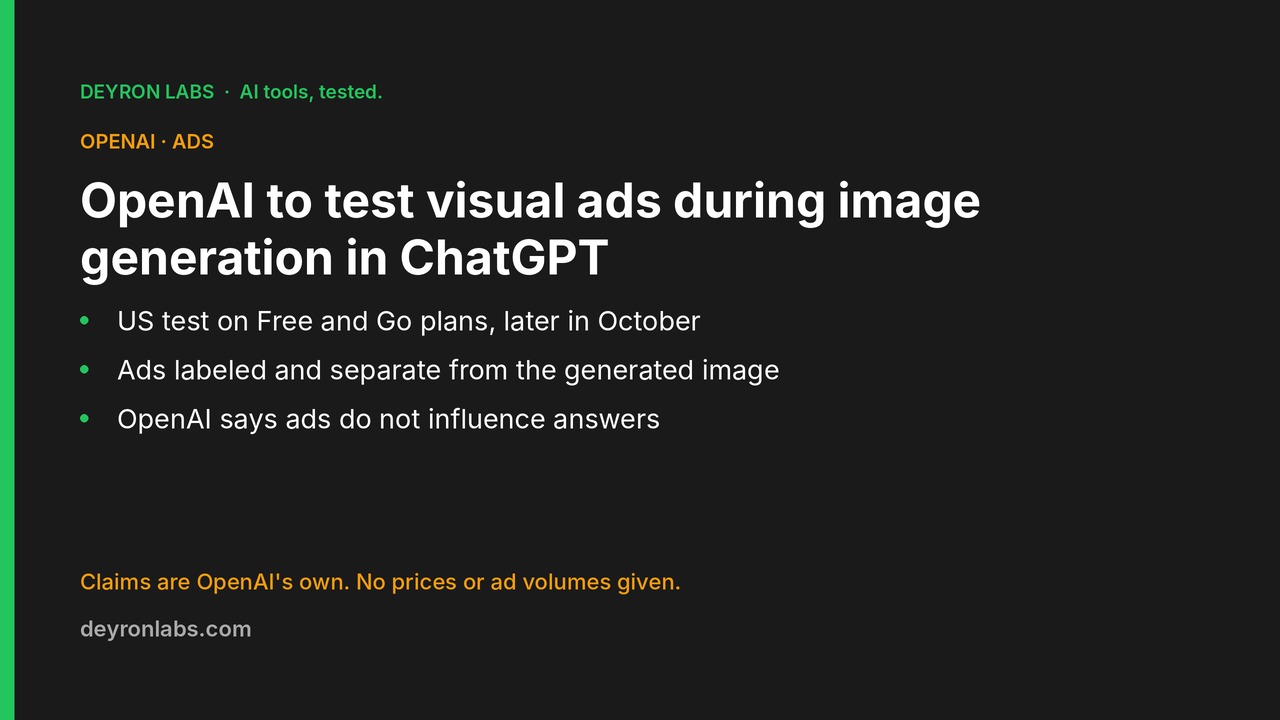
On 5 October 2026, OpenAI published “Building advertising for the way people use AI”, announcing a new visual ad format that appears while a user generates images in ChatGPT. OpenAI says the ads show product inspiration, product usage or the experiences a product makes possible, and that they are clearly labeled and kept separate from the generated image.
Key details
- Who and where: the test starts in the US and targets users on the Free and Go plans. OpenAI says testing begins later in October 2026 with an initial group of advertisers.
- Answer independence: OpenAI states that “advertising does not influence the answers ChatGPT provides”. We could not verify this independently.
- Reach claim: OpenAI says ChatGPT reaches 1.2 billion people each week.
- Measurement tools for advertisers: conversion-data integrations with Hightouch, Tealium and LiveRamp; attribution support through partners including AppsFlyer, Adjust and Kochava; geo-based incrementality experiments with Haus, Measured and WorkMagic, which OpenAI describes as early-stage; and brand-suitability pilots with DoubleVerify and Integral Ad Science that, OpenAI says, do not give them access to private conversations.
- Not in the post: prices, ad volumes, and how often users will see the ads.
Why it matters
If you use ChatGPT’s free or Go plan in the US, image generation may start to include a labeled ad next to your result later this month. Paid-plan users are not named in the announcement.
The longer-term signal is that OpenAI is extending its advertising business into generation tools, not only text answers. How the ads are labeled and separated, and whether the separation from answers holds in practice, are things to watch once the test begins.
Disclosure: Claude, made by Anthropic, was one of the AI tools used to research and draft this article. Anthropic is a competitor of OpenAI. Claims about the ad format are OpenAI’s own.
Sources
- Building advertising for the way people use AI Primary source , OpenAI