What happened
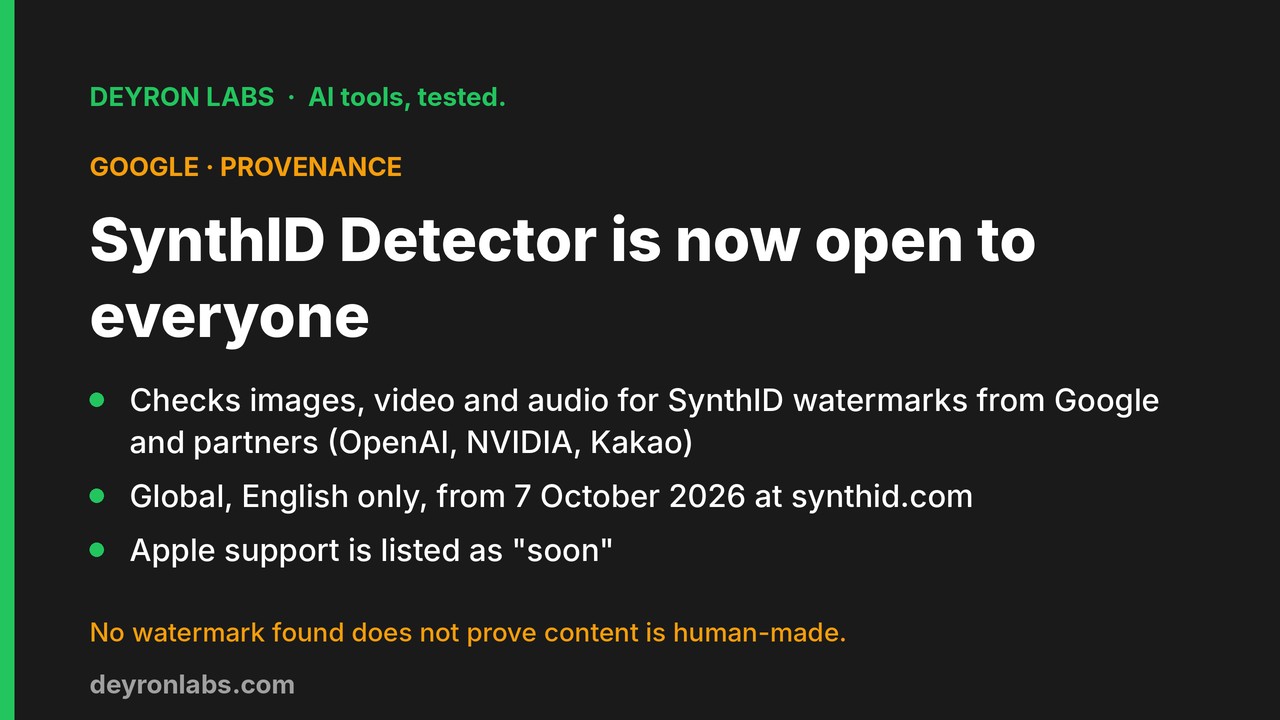
On 7 October 2026, Google DeepMind published a post by Pushmeet Kohli, “We’re making it easier to identify AI-generated content globally”. It says SynthID Detector is now open to the public. Last year Google introduced an early version for media professionals; this release removes that restriction. In Google’s words, “anyone can easily check if an image, video, or audio file was made with AI from Google or our partners”. The tool is at synthid.com.
SynthID is Google’s system of imperceptible watermarks embedded in AI-generated media. The detector reads those watermarks back. It is available globally, in English only, from 7 October.
Key details
- What it checks: images, video and audio, for SynthID watermarks.
- Whose watermarks: Google’s own AI tools plus partners. The post names OpenAI, NVIDIA and Kakao. Apple is listed as coming “soon”, so Apple’s watermarks are not yet covered.
- Scale, per Google: Google says it has watermarked “over 180 billion images and videos” and “240,000 years of audio content”. These are Google’s figures and we have not verified them independently.
- Built-in checks: Google says verification features in Search, the Gemini app and Chrome “now regularly handle over 1 million requests daily”.
- What the post does not say: how a file is submitted, file size or format limits, what the result looks like (for example a label or a confidence score), known weaknesses, or how this relates to content-credential standards such as C2PA. We read the post and the tool’s page on 8 October 2026 and found none of these details there.
Why it matters
The practical value is for anyone who needs to answer “was this made with a Google or partner AI tool?”. Creators who label AI-made media, journalists checking a viral clip and platforms handling uploads can now run that check without applying for access.
The limit matters just as much. The detector looks for one family of watermarks. A file with no SynthID watermark may still be AI-generated by a tool outside Google’s partner list, and the post does not claim otherwise. Treat a positive result as strong evidence of origin and a negative one as no evidence either way.
Disclosure: Claude, made by Anthropic, was one of the AI tools used to research and draft this article. Claims about the tool and the watermark counts are Google’s own.
Sources
- We're making it easier to identify AI-generated content globally Primary source , Google
- SynthID Detector Primary source , Google