What happened
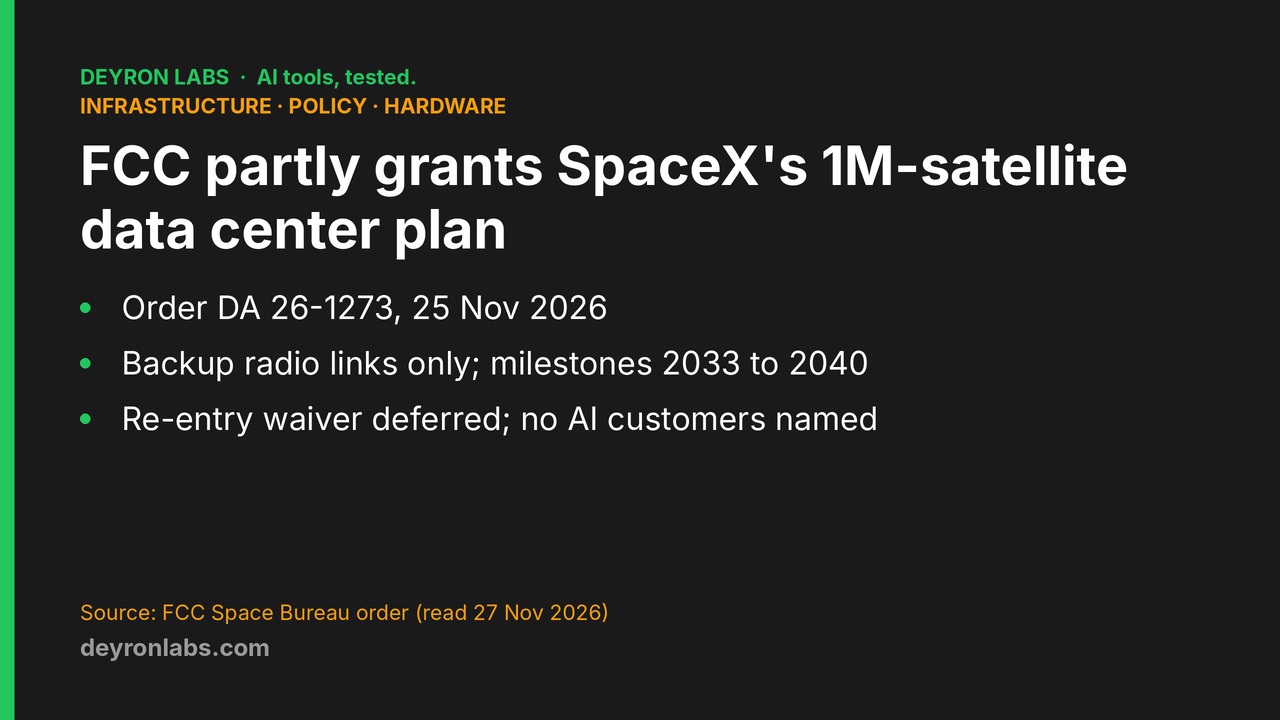
On 25 November 2026 the Federal Communications Commission’s Space Bureau issued Memorandum Opinion and Order and Authorization DA 26-1273 on SpaceX’s application for the “SpaceX Orbital Data Center System”, called Starmind. The application covers a non-geostationary constellation of 1,000,000 satellites in shells spaced 50 km apart between 500 km and 1,002 km altitude. The Bureau granted it in part and deferred it in part, with conditions. We read the order text on 27 November 2026.
Key details
- What was actually authorized: the order authorizes radio-frequency use for backup and emergency telemetry, tracking and command in the Ka band (18.8 to 19.3 GHz and 28.6 to 29.1 GHz), on an unprotected, non-interference basis. The order says the main communications are optical links, including to Starlink.
- Milestones (condition 10): one satellite in orbit by 25 November 2033; 10% of the constellation by 25 November 2035; 50% by 25 November 2038; the rest by 25 November 2040. The license runs 15 years from the first satellite, and the authorization becomes void if a milestone is missed.
- Deferred: SpaceX’s request for a waiver of the rule on atmospheric re-entry for satellites below 2,000 km. SpaceX must file an amendment before launching satellites above 600 km without a re-entry plan. SpaceX must also file semiannual reports on 1 January and 1 July.
- Objections: petitions from Viasat, Amazon’s Kuiper (Amazon Leo) and the American Astronomical Society were denied. The order treats concerns about optical astronomy and the environment as outside the FCC’s remit in this proceeding.
- Not in the order: it does not mention Anthropic or Google, any payment or capacity commitment, a launch date, or whether orbital data centers are technically or economically feasible. The Wall Street Journal reported on 26 November that Anthropic and Google had committed billions of dollars for capacity; we could not read that article (paywall) and have not confirmed it from a primary source.
Why it matters
The grant is narrower than the headline “1 million data center satellites” suggests: it clears radio links for a constellation, not a working orbital data center, and the first satellite is not due until 2033. The milestone conditions mean SpaceX has to show real deployment on a fixed schedule or lose the authorization.
For AI infrastructure, the order is a regulatory step, not evidence that compute in orbit works at scale. Watch for SpaceX’s re-entry amendment, any customer confirmation from a primary source, and the first launch.
Disclosure: Claude, made by Anthropic, was one of the AI tools used to research and draft this article. Anthropic is named in the Wall Street Journal’s report on this story, which we could not verify. Deyron Labs is not affiliated with SpaceX, Anthropic or Google.
Sources
- FCC authorizes 1 million satellites for data centers in space (Memorandum Opinion and Order and Authorization, DA 26-1273) Primary source , Federal Communications Commission, Space Bureau, 25 November 2026, read 27 November 2026
- DA 26-1273 order text (ICFS SAT-LOA-20260108-00016, call sign S00798) Primary source , Federal Communications Commission, read 27 November 2026
- FCC authorizes SpaceX to build 1 million data centers in space (paywalled; not read, cited only for the Anthropic and Google claim) The Wall Street Journal, 26 November 2026