What happened
On 7 October 2026, OpenAI published an update on ChatGPT for Teens, the experience that accounts identified as under 18 get by default. The update announces a College Planner, new flashcards and quizzes, a partnership with the nonprofit College Advising Corps, and support for a student advisory council at Boston Children’s Hospital’s Digital Wellness Lab. It also shares usage statistics about teens on ChatGPT.
ChatGPT for Teens itself is not new. The Associated Press reported its launch in August 2026 as a version of ChatGPT for users aged 13 to 17, with blocks on self-harm and romantic or sexual content and optional parental controls.
Key details
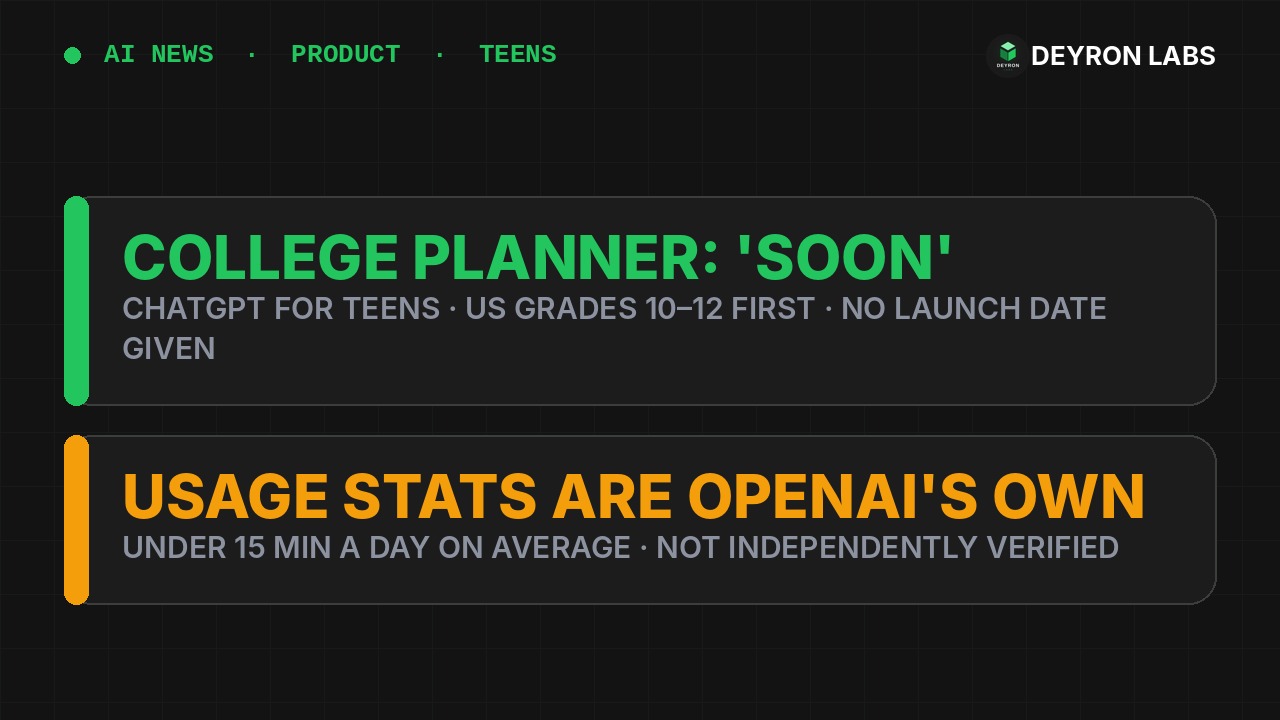
- College Planner (not yet available): OpenAI says it is coming “soon”, first for US high-school students in grades 10–12 who plan to attend a four-year college. It would combine application requirements, deadlines, tasks and financial-aid steps for the schools on a student’s list into one plan, and help track aid deadlines, scholarships and fee waivers. OpenAI says it does not decide where students apply and is meant to support counselors, advisers and families, not replace them. Expansion to other countries, two-year colleges, technical colleges and trade schools is planned, with no dates.
- Flashcards and quizzes (announced as available): students can generate flashcards from uploaded notes or a topic, mark cards as known, revisit missed ones and shuffle decks, and decks save to their Library. Quizzes can be built from uploaded notes. Continuous multi-photo capture, which merges several note pages into one PDF, is on iOS, with Android in progress.
- Partners: OpenAI’s contribution will help College Advising Corps expand into new states and start an AI fellowship program for advisers. OpenAI will also support the Digital Wellness Lab’s Student Advisory Council over three years; for 2026–27 it has about 22 students, who are expected to give feedback on safety defaults, parental controls and notifications, and AI literacy.
- Usage figures, all OpenAI’s own: teens spend under 15 minutes a day on ChatGPT on average, and fewer than 2% spend more than three consecutive hours. Nearly 1.2 million teens used Learning Visualizations in one week and more than 180,000 used Study Mode. OpenAI says teens “with access” sent about 2.7 million more learning-related messages on average than those who did not have it yet; the page does not make clear what the access refers to. It also says hundreds of thousands of US teens use ChatGPT each week to plan for college.
- Break reminders: OpenAI says that in almost half of teen conversations where a break reminder appeared, the teen took a break or ended the conversation within five minutes.
- Comparison with social media: OpenAI sets its under-15-minute average against a publicly reported average of 5 hours of daily teen social media use, citing the American Psychological Association. That comparison is OpenAI’s framing, not an independent one.
- What the page does not say: it does not explain how accounts are identified as under 18, and it does not describe parental controls or age prediction as new features. It calls its progress “early”.
Why it matters
For teens and parents, the concrete changes are the study tools, which are described as available, and the College Planner, which is not. Anyone planning around the Planner should wait for an actual launch: the date, the countries beyond the US and the cost are all unstated.
The statistics deserve a careful read. OpenAI chose which numbers to publish, the page gives no methodology we could find, and the comparison with social media is a favorable one. We found no independent verification of the usage figures, and the more-messages figure does not say which groups or time period it compares. Time-on-site averages can also hide a long tail of heavy users, which OpenAI addresses only partly with its “fewer than 2%” figure.
The partnerships with College Advising Corps and the Digital Wellness Lab show OpenAI trying to put outside voices around a product used by minors. Whether the advisory council changes safety defaults or parental controls is something to watch for in later announcements.
Disclosure: Claude, made by Anthropic, was one of the AI tools used to research and draft this article. OpenAI is a competitor of Anthropic. Usage claims are OpenAI’s own unless stated otherwise.
Sources
- Teens learn and plan with ChatGPT (OpenAI, 7 October 2026) Primary source , OpenAI
- OpenAI launches ChatGPT for Teens, promising a more age-appropriate chatbot (August 2026) Associated Press (via WTOP)