What happened
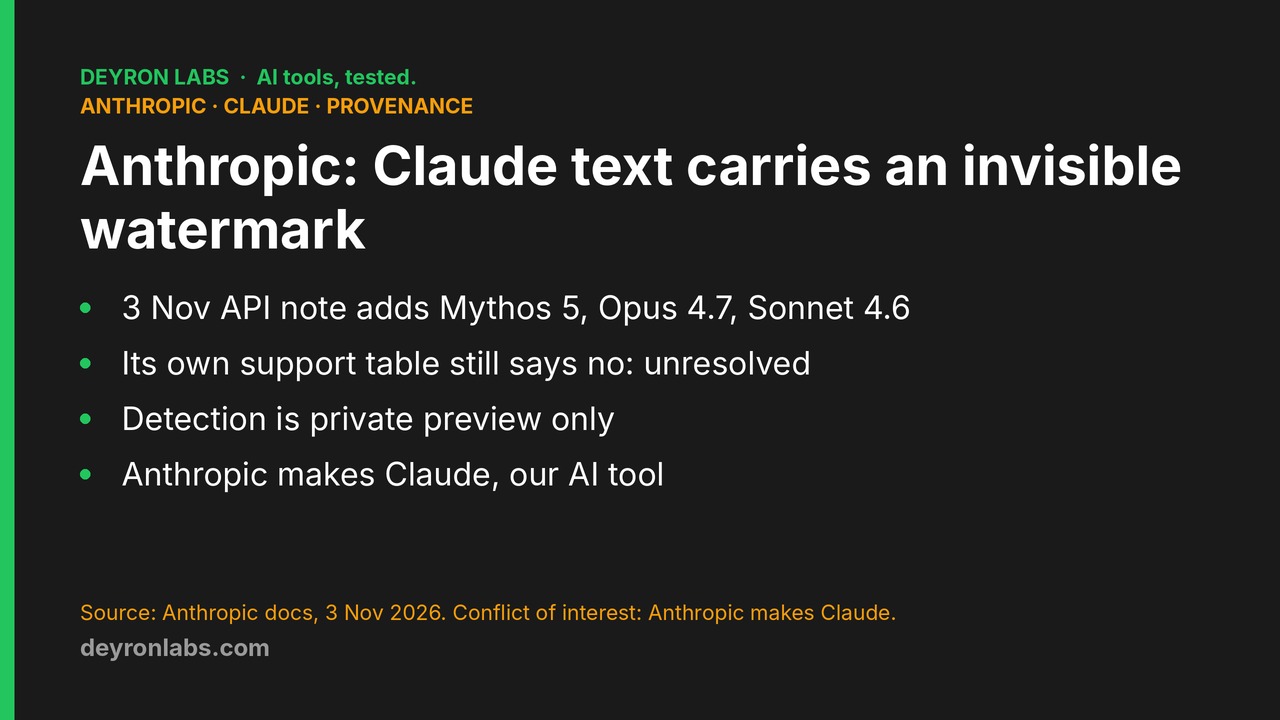
The Claude Platform release notes entry dated 3 November 2026 says: “Text generated by Claude Mythos 5, Claude Opus 4.7, and Claude Sonnet 4.6 carries Anthropic’s text watermark on the platforms listed in How Claude marks AI-generated content.” Anthropic’s documentation describes the text watermark as part of how it marks AI-generated content, and its support article says Anthropic signed the EU AI Act Article 50(2) Code of Practice on Transparency of AI-Generated Content.
Key details
- What it is: according to Anthropic, the watermark is “woven” into the text itself and is imperceptible. The documentation says it “adds no tokens or hidden characters and carries no information about you or your organization”, and that developers do not need to change their requests.
- Who can detect it: “Watermark detection is currently in private preview”, offered to eligible organizations such as regulators, law enforcement, media, fact-checkers, researchers, educational organizations and EU civil society groups, through a request form. Anthropic says it plans to expand access over time. Ordinary users cannot check text themselves.
- Limits stated by Anthropic: a detected mark “is not fully conclusive”, a missing mark does not show that content was not AI-generated, and the mark “may persist through some editing”. For images, Anthropic uses signed C2PA Content Credentials instead, with a free checker.
- Sonnet 4.6 caveat: text for a request that sets
temperature,top_portop_kto a non-default value “might not carry” the watermark. Developers who rely on it should omit all three parameters. - Where it applies: Claude Platform (API), Claude, Claude Code, Claude Cowork and Claude Tag, and through AWS, Google Cloud and Microsoft Foundry.
- A conflict in Anthropic’s own pages: the support article’s model table marks Fable 5.1, Fable 5, Mythos 5.1, Opus 5.5, Opus 5, Opus 4.8, Sonnet 5.5, Sonnet 5 and Haiku 5.5 as watermarked, and Mythos 5, Opus 4.7, Sonnet 4.6 and older models as C2PA only. The 3 November note says the second group now carries the watermark. The support page says Anthropic “is adding watermarks to outputs from models released before August 2, 2026”, so this may be a rollout in progress; the page has no exact date. We could not tell which page is current.
- Not documented: an opt-out. We found none in the pages we read.
Why it matters
For people who publish text written with Claude, this means the output may carry a signal that approved organizations can check, without anything visible changing. Because detection is limited to private-preview participants and Anthropic itself calls a result inconclusive, it is a signal, not proof of origin.
Developers using older Claude models should check whether their outputs are now marked, and teams that set sampling parameters on Sonnet 4.6 should know the mark may be missing. OpenAI announced a similar EU-focused text watermark in October 2026; both reflect the transparency rules taking effect in Europe.
Disclosure: Claude is made by Anthropic and is one of the AI tools Deyron Labs uses to research and draft articles, including this one, which is about Anthropic. All statements about the watermark are Anthropic’s own, read from its documentation on 3 November 2026.
Sources
- Claude Platform release notes (3 November 2026 entry) Primary source , Anthropic
- Text watermark (Claude Platform documentation) Primary source , Anthropic
- How Claude marks AI-generated content (Claude support) Primary source , Anthropic